Friday, May 28, 2010

Monster Movie of the Week: Godzilla vs. Mechagodzilla (1974)


GODZILLA VS. MECHAGODZILLA (1974)
Director: Ichiro Honda
Genre: Kaiju eiga
Country: Japan

THE MOVIE


By the mid-1970’s, the Godzilla series was beginning to fizzle out with increasingly silly and cheaply made entries into the franchise. Movies like Godzilla’s Revenge and Godzilla vs. Megalon represent an all time low for the series. These movies introduced us to characters like Jet Jaguar, an Ultraman wannabe who can change his size at will, an army of short shorts wearing Kennys and the most horrifying incarnation of Godzilla’s spawn, Minya, who is a spiritual forefather to both Jar Jar Binks and the Ewoks.

If his father is Godzilla, then who's his mother? Carol Channing?


While 1974’s Godzilla vs. Mechagodzilla is a step above those entries, it is also fairly representative of this fairly miserable period in Godzilla’s history. It features the hated “Muppet” Godzilla suit with its googly eyes and throw pillow dorsal spines as well as a cheesy plot involving yet another group of aliens trying to take over the earth. What’s more telling is the movie’s plot, in which aliens attempt to frame Godzilla by building a mechanical doppelganger. Think about that for a second. At this point in Godzilla’s career he has lost so much street cred that he can actually be framed for destroying a city. When a monster is prophesied to destroy the earth, one of the characters states, “I never thought it would be Godzilla.” Um, what? At some point between 1954 and 1974 Godzilla went from nuclear hell beast to Cookie Monster.

Cooookies!

That being said, the movie does introduce us to one Godzilla’s most popular antagonists, Mechagodzilla, who was one the few monsters from the late Showa movies to actually be carried over into the later Heisei and Shinsei series of movies. Mechagodzilla is, of course, a mechanical version of Godzilla.

In these later Showa movies, Godzilla and his opponents always manage to meet up in strangely deserted rural areas.

In his original two Showa appearances he is an evil robot created by aliens to fight Godzilla. In this movie he even sports a fake skin so that he can impersonate the big guy, sort of a kaiju version of the Terminator. The Showa Mechagodzilla has remained a popular character due to his unique powers and retro design. There doesn't seem to be any part of his body that does not shoot lasers or missles and he even features finger and toes projectiles. The classic Mechagodziila is more portly and less svelte than his later versions and is made from “Space Titanium” with a boilerplate aesthetic that is almost steampunk by today’s standards.

This movie also popularized the "mecha" concept in the Godzilla series, although it was previously introduced in the Toho-verse in King Kong Escapes, which featured Mechanikong. In addition to the other two Mechagodzillas, there was also a cyborg version of King Ghidorah in 1991's Godzilla vs. King Ghidorah. In the cartoon series based off of the American Godzilla movie, the mechanically resurrected version of that monster was known as Cyber Godzilla.


INFLUENCES/RIPOFFS


I love Godzilla movies but they are pretty shameless in their, um, homages to other movies. This movie features some dreadful gorilla aliens that can only have been inspired by the then popular Planet of the Apes movies and an Interpol subplot seemingly rejected from a James Bond movie.

"This is another fine mess you've gotten us into Cornelius."


MONSTERS/EFFECTS

This movie also features an appearance from Anguirus who looses a surprisingly bloody fight to Mechagodzilla that ends with a neat visual reference to King Kong. King Seesar makes his first (and until 2004, his only) appearance. Seesar is an monster visually inspired by various Asian mythological creatures, although his little statue actually looks a lot cooler than he does. He can only be described as a dragon/bunny/monkey man who has reflective eye powers and no other abilities to speak of.

King Seesar's day job consists of sitting in front of a Chinese restaurant.

DVD AVAILABILITY


Available in various versions. The movie was re-released back in the late 1990’s in time for the American Godzilla movie.

SEQUELS

Mechagodzilla, shooting his LSD ray.


Okay, this movie was directly followed by Terror of Mechagodzilla the next year marking the creature’s second appearance and the end of the Showa series of Godzilla movies.

Mechagodzilla also appeared (as a human creation based on technology recovered from Mecha King Ghidorah) in 1993’s Godzilla vs. Mechagodzilla II which was NOT a sequel to this movie.

In the Millenium series, came a pair of movies (the only interconnected movies in that series), Godzilla Against Mechagodzilla and its sequel Tokyo SOS which again featured Mechagodzilla as a human creation designed to battle Godzilla and in this case a cyborg made from the bones of the ’54 Godzilla.

Anguirus and King Seesar would both not appear again until 2004’s Godzilla Final Wars. Anguirus would become a mainstay of Atari’s Godzilla fighting games starting with 2001’s Destroy All Monsters Melee and Seesar would make his first fighting game appearance in Godzilla Unleashed for the Wii, which also features all three Mechagodzillas as playable characters.

TRAILER


Wednesday, May 26, 2010

LOST Is Questioned.


Somehow people have put it in their heads that if you tell them you saw the LOST finale that's an open invitation for them to then tell you:

A) They loved it.
B) They hated it.
C) No Ricky I didn't dress up as Kate to watch it.


Now say what you will about the episode, dressing up as Kate ranks right up there when I dressed up as Kirstie Alley for the final episode of Cheers. And I had the outfit first Evangeline.

Looking back, I think about the finale of LOST the same way I think about sex, "It's over now. Let's move on. Why can't I stop crying?" It's no coincidence that the last thought is a question. LOST was about questions. Some were answered. Others were not. Here's a pretty solid list of questions that were not answered as asked by College Humor's Jeff Rubin.


Follow me on Twitter here!

Sunday, May 23, 2010

For Us Fu@*&in' Dorks Who Love LOST

Tonight is the final episode of LOST. Here's an exclusive look with Sarah Silverman.


Saturday, May 22, 2010

MONSTER MOVIE OF THE WEEK-DAMN DIRTY APE EDITION-PLANET OF THE APES (1968)


PLANET OF THE APES (1968)
Director: Franklin Schaffner
Genre: Sci-Fi

THE MOVIE

Few movies have had the legacy and made the social impact of the classic 1968 science fiction movie, Planet of the Apes. Like another 1968 science fiction movie that featured ape creatures, 2001: A Space Odyssey, Planet of the Apes was from those heady days when science fiction films were about Big Ideas and using the trappings of the genre to make a philosophical or socio-political commentary about the world. It was produced before a time when the genre became a playground for action and special effects. Compare it to its very inferior 2001 remake, which was about nothing and had nothing to say. Many essays and papers have been written about the movie and its subtext. In fact, an entire book has been written about the movie and its sequels and how they serve as a commentary on 1960’s America: Eric Green’s very interesting, Planet of the Apes as American Myth: Race, Politics, and Popular Culture.

The movie is also a pop cultural landmark and even people who have never seen Planet of the Apes can be found referencing or quoting it. The movie starred the late Charlton Heston, who chewed out some memorable lines such as “Take your stinking paws off me, you damn dirty ape!” and “It’s a mad house! A mad house!” The term “Planet of the Apes” has come to be a short hand for any kind of situation in which the expected social order has been reversed. Perhaps the movie is most famous for its shocking twist ending, which has since become one of the most iconic moments in the history of cinema.

Planet of the Apes is very loosely based on the French novel of the same name and written by Pierre Boule as a sort of Swiftian satire on human society. The book was adapted by Rod Serling of the beloved TV show, The Twilight Zone. As he often did with his show, Serling infused Planet of the Apes with subtextual social commentary, profound irony, and surprising plot twists. The other writer to have worked on the script for Planet of the Apes was Michael Wilson, who had been blacklisted during the McCarthy era and who no doubt added his bitterly anti-establishment sentiments in the depiction the ape society.

Apes was also one of the first movies to spin off into a real multimedia franchise. The movie was followed by four sequels and later both an animated and a live action TV series. Because of the series’ popularity with children, Planet of the Apes was one of the first movies to feature a line of action figures and other products, paving the way for the merchandising bonanza that followed the Star Wars movies.

Planet of the Apes is the tale of a misanthropic astronaut named Taylor, who is the leader of an expedition to a distant planet. The details of the expedition and its intent are a little murky but Taylor travels with three astronaut companions. It is implied that the four astronauts were to colonize a distant planet. However, while they are in hibernation, their ship crash lands on a mysterious planet where the Taylor and the two other survivors encounter a race of primitive, mute human beings. No sooner are Taylor and the others ready to divvy up the planet for themselves, when they are attacked by a hunting party of apes who talk and ride horses. Taylor is injured in the attack and he is captured and caged like an animal.

As stated above, Charlton Heston portrays Taylor in a bit of casting that is weird but perfect. At the time, Heston was a movie star well known for his heroic roles and was almost a symbol traditional blond-haired, blue-eyed American manhood. In Apes, he plays an edgy antisocial character who is literally stripped, beaten, and humiliated. I’ve often wondered why the famously conservative actor (he was the spokesperson for the NRA) was attracted to this script with its clearly left-wing subtext.

Taylor is befriended by a pair of chimpanzee scientists (Kim Hunter and Roddy McDowell) who discover that he has the ability to speak, which no human has demonstrated on the Planet of the Apes. We also learn that the ape society is stratified into three classes: the gorillas serve as the workers and the military, the chimps are the scientists and intellectuals, and the fair-haired orangutans are the political and religious leaders. It doesn’t seem that individual apes can break out of these social roles.

Taylor and his chimp friends are brought before an ape council lead by the shady Dr. Zaius. Taylor’s ability to speak and his demonstrated intelligence threaten the ape society and he is sentenced to castration and lobotomy before he escapes and explores the “Forbidden Zone” where the chimpanzees have discovered proof of an advanced pre-simian civilization. At the end of the movie, the true history of the Planet of the Apes is revealed.

THE MONSTERS/EFFECTS

Sorry Mr. Heston, but the real star of Planet of the Apes is the incredibly expressive make-up created by John Chambers. Over forty years later, this make-up still holds up and manages to create the illusion of talking ape characters while still allowing the actor’s performance to be expressed naturally on camera and never once looking silly. Foam appliqués over the mouth and brow give the characteristic simian look to the face. The only drawback to this is that the ape teeth are actually built into the flexible foam mouthpiece and can move in an unnatural way during speech.

MOST MEMORABLE MOMENT

“You maniacs! You blew it all to hell!”

DVD AVAILABILITY

The Apes movies have been fortunate to have received a lot of home video love over the years. Of course, Planet of the Apes is available on its own, but I suggest you take a look at the some of the boxed sets which are very nice. On DVD, the most recent one is the Legacy Collection. If you have a Bluray player, check out the 40th Anniversary Collection, which can frequently be bought on Amazon for fairly cheap. The video transfer is amazing considering the movie’s age and Planet of the Apes has never looked better. The set includes the great documentary Behind the Planet of the Apes, which is interactive on the Bluray. The Bluray set also includes a beautifully illustrated book about the series and the very rarely seen extended cut of Conquest of the Planet of the Apes. It’s really a fantastic set and if you are a fan of these movies, you should definitely pick it up.


SEQUELS

This movie was immediately followed by the sub-par (no pun intended) Beneath the Planet of the Apes (1970) and the surprisingly good Escape from the Planet of the Apes (1971) and two others.

TRAILER


...my all time favorite Simpsons moment


Friday, May 21, 2010

Have You Talked To That New LCD Soundsystem?


Here's two reasons why you should pick up LCD Soundsystem's new album This Is Happening.

Reason #1:


Reason Numero Dos:


Simple enough right? Go talk to that. It will do you no harm.

Friday, May 7, 2010

MONSTER MOVIE OF THE WEEK: THE BLOB (1958)


The Blob (1958)
Director: Ivan Yeaworth
Genre: Teen/Sci-Fi/HorrorTHE MOVIE

It's hard to believe that there was a time when there were not movies aimed at teen audiences. While today, a huge chuck of movies and media are aimed at the free-spending teen market, it was only in the 1950's that a distinct "teen culture" emerged, with its own stars, music, and movies. The Blob is aimed directly at that audience and quite shamelessly panders to it with its group of young heroes who rally to save their town from an alien menace despite the clueless and disbelieving adults. It also introduced moviegoers to Steve McQueen who went on to become an iconic American movie star.


Among all of the schlocky 1950's monster movies, The Blob stands out as one of the more memorable ones and has a rich legacy in American pop culture. The movie also features one of the most unique movie monsters of its time. The Blob also had it's own comedic sequel in the 1970's, Beware! The Blob and a pretty cool 1988 remake. Rumor has it that a new remake is in preproduction to directed by Rob Zombie. The movie also popularized the word "blob" into the public lexicon, to the dismay of fat kids everywhere.


THE MONSTER/EFFECTS

Believe it or not, the Blob is actually based on an observed phenomenon: Star Jelly, a gelatinous substance that has been observed around meteorites (although still not scientifically verified). An incident of Star Jelly in the '50's actually inspired The Blob. Despite the technicolor 1950's presentation, the Blob seems to have its roots in Lovecraftian horror, because, if nothing else, H. P. Lovecraft sure loved him some shapeless slimy monstrosities.

While in its purest form, the Blob is nothing more than a slimy gelatinous mass but during the course of the movie, it attaches to people, consumes them and grows to a larger size, until it is able to wrap itself around a small diner. As far as movie aliens go, the Blob is actually quite credible. Instead of a big-headed tentacle monster who arrives on a flying saucer, I can totally buy a simple, voracious overgrown germ which hitches a ride on a meteor. As a monster is rife with horror, but this movie, understandably, plays it a little safe. I mean, the possibilities are certainly there: a creature than can envelope, suffocate, and consume you and is translucent so you can see it happening is pretty hardcore.

The effects, while effective for 1958, leave a lot to be desired as far as selling the creature, usually the Blob is being pretty obviously manipulated by someone off camera.

MOST MEMORABLE MOMENT

The creature's slow consumption of the old man at the beginning of the movie is quite effective, as is the make-up application. It's a genuinely creepy element of body horror.

DVD AVAILABILITY

Available in a nice Criterion Collection set on DVD.

No Bluray as of yet.

SEQUELS

Beware! The Blob 1972

THE TRAILER


Tuesday, May 4, 2010

MONSTER MOVIE OF THE WEEK: HOW TO TRAIN YOUR DRAGON (2010)


HOW TO TRAIN YOUR DRAGON (2010)

Genre: Family/Animation/Comedy
Directors: Chris Sanders, Dean DeBlois

THE MOVIE

When it comes to quality animated features, Dreamworks doesn't have the track record of
Pixar, and for every Shrek and Kung Fu Panda, there are a bunch of snarky kiddie movies filled with smirking, pop-culture referencing characters. How to Train Your Dragon is a big step above the usual Dreamworks fare and better than some of the lesser Pixar movies. It was released as part of the post-Avatar 3D boom and actually takes advantage of format very well for some very thrilling sequences.

How to Train Your Dragon is the story of a Viking tween named Hiccup (who seems to be physically modeled on Jon Krasinski, although voiced by Jay Baruschel), who is the son of the chieftain of a remote village which is at war with bands of dragons which frequently attack. The whole culture of the village is based on fighting with dragons, and it is considered a coming-of-age ritual to kill one. Hiccup is smarter than he is tough, and spends most of his time sketching and inventing contraptions. As the son of the leader, he is at once sheltered and under pressure to prove himself. During a particular nasty dragon attack on the village, Hiccup sneaks off with his new invention, a kind of net catapult which manages to actually down a dragon somewhere outside the village.

The next day, Hiccup ventures off to find the beast to finish it off and discovers a rare black dragon, the Night Fury, bound and injured by his net. As much as he wants to prove himself to his father and his peers, Hiccup cannot bring himself to kill the wounded animal , and releases it into the large sinkhole in which it has crashed but from which it cannot escape due to its injured tail fin. Hiccup and the the dragon, Toothless, gradually build up trust and a touching friendship a la Elliot and E.T, Hogar and the Iron Giant, etc. Meanwhile, Hiccup is being forced by his father into training to be a dragon slayer. Of course, things come to a head, and Hiccup must make a choice about what he is to be and he discovers the secret behind the source of the dragon attacks on the island.

I really like this movie a lot. Hiccup actually becomes a very appealing character by the end of the movie. It is always interesting to watch a character forced to choose between the fate that has been assigned to him and the fate that he knows is right. Over the course of the movie, Hiccup follows his instincts and becomes a kind of naturalist and he has a transformational effect on the other villagers his age. For kids, it teaches a great lesson about the value of patience and observation over knee-jerk violence.


THE MONSTER/EFFECTS

How To Train Your Dragon features quite a few dragon designs and most of them are very whimsical. All of the different dragon species have their own distinctive abilities which have all been compiled by the movie's resident dragon expert into a book which is reminiscent of the Dragonology books that have become popular with kids. How To Train Your Dragon itself is very loosely based on a series of kids books.

The only two non-cartoony creatures are Toothless and the giant Godzilla-sized alpha dragon at the end of the movie. Toothless is wonderfully designed and animated and is probably the best and most original dragon character ever put to film. With his big yellow eyes and pointy "ears, " and slinky feline movements he manages to evoke a giant cranky black cat. I'd be shocked if he wasn't directly based off of one of the animator's pet cat. Toothless is the epitome of the giant powerful creature that all little boys fantasize about befriending. As his species distinctive "power," Toothless is able to produce a kind of weird purple plasma shockwave bolt from his mouth. The directing team for How To Train Your Dragon was also in charge of Disney's Lilo & Stitch and there is a lot in common in how they handle both central creatures. They have a great way of bringing out personality and character in these animated creatures.


DVD AVAILABILITY

Still in theaters as of this writing.

MOST MEMORABLE MOMENT

The first scene between Hiccup and Toothless really clues you in to the fact that you are into something special. You can see a bit of it in the trailer, as Hiccup approaches the bound dragon and you can see the look of suspicion and then resignation on Toothless' face. This is a really well-animated, silent scene which is a rare thing in the very high energy world of Dreamworks animated movies where characters are always working non-stop to entertain you. This scene really gets me.

SEQUELS

This movie has been doing quite well at the box office and Dreamworks has just greenlit a sequel, setting this up to be their new animated franchise with the retirement of Shrek.

SEE ALSO
E.T. 1982 The Iron Giant 1999 The Water Horse 2007 King Kong 2005 Gamera The Brave 2004

THE TRAILER


Monday, May 3, 2010

Happy Birthday James Brown Good GodZammaBammaZeeerreeeeeYouuuuu!


It's James Brown's Birthday Today! HEH!

Let's remember the funny times. HAAAAAAIH!


Let's remember the funky good times AAAAAAINNNH!


Let's not forget the not so good times SHO' YA' RIGHT!


And then there's the Holy Goddamn What Is This shit times ZIIIIIIREEEEYOUUUUUUU!!!!

Friday, April 30, 2010

The Boondocks Strikes Back!


May 2nd marks the long-awaited third season of Cartoon Network's animated series, The Boondocks, based on Aaron McGruder's popular comic strip of the same name, which ran until 2006. The series offers sharply-scripted satire about an African American family transplanted into a mostly-white suburb. The Boondocks has attracted its fair share of controversy for its often hard-hitting racial humor, its sometimes misogynistic and homophobic language and its almost constant use of the word "nigga."

The Boondocks
features lots of memorable characters, but the heart and conscience of the show is young Huey Freeman, an afro'd, precocious, martial-arts trained, kid who considers himself a throwback to the black power movement of the 1960's. As reprehensible as some of his surrounding characters can be, we can almost always count on Huey to be the voice of responsibility and commonsense. If the show were not so often from Huey's voice, it would be an exercise in awful stereotypes and shock humor. His brother is Riley, a wanna-be gangsta, who is obsessed with the violent and materialistic side of Hip-Hop culture. The two boys are being raised by their grandfather, Robert Freeman, a crotchety relic of the Civil Rights movement who is trying to enjoy a quiet retirement. The most controversial character is Uncle Ruckus, a black white supremacist who is constantly spouting some of the most awful racial epitaphs and black stereotypes you have ever heard.

Despite the painfully long production gaps between seasons (this is rumored to be the last one) and the very uneven second season, The Boondocks deserves to stand with series like The Simpsons and South Park as one of the funniest and smartest animated shows of all time. In addition to sometimes brilliant writing, The Boondocks also features high quality Japanese-style animation and is often beautiful to look at in a time when the norm for animated comedy programs is animation that is cheap and ugly.

It's been a couple of years since the last episodes of the show have aired and the racial equation has changed somewhat in America. I am curious to see how The Boondocks will fare in the supposedly post-racial Age of Obama. The first episode of season three looks to take this topic on and is called, "It's a Black President, Huey Freeman." Sadly, comedy waits for no man, and I can't help feeling like this was an episode that should have aired a lot sooner, but for The Boondocks, I am willing to set the clock back a year and a half.
In preparation for the new season lets count down the top ten episodes from seasons one and two.

10. "Attack of the Killer Kung Fu Wolf Bitch," Season 2. The Boondocks is sorely lacking strong female characters and can often lapse into a kind of cheerful misogyny (despite the fact that Huey and Riley are both voiced by a woman). African-American women in particular usually only appear as crazy or prostitutes on the show, and "Attack of the Killer Kung Fu Wolf Bitch" introduces us to Luna, who is the former. As part of his ongoing attempts to hookup online, Granddad makes a date with Luna, a beautiful young woman with a tragic past, low self-esteem, deadly Kung Fu skills, and a girlfriend who is constantly feeding her unhealthy relationship advice via a Bluetooth headset. Luna actually turns out to be a fairly sympathetic and appealing character, which is a shame because the episode treats her pretty badly.

Despite the mishandling of the Luna character, this is one of the more fun and energetic Season 2 entries and has some of the series' best animation. Also, this is one of the few cases where the martial arts sequences are not gratuitous and actually feel like an organic part of the story. Look for the hilarious references to Enter the Dragon and Mortal Kombat.

9. "Granddad's Fight," Season 1. This one introduces us to Colonel Stinkmeaner, a supernaturally hateful and mean old blind man, who gets into an unnecessary altercation with Granddad in the parking lot of a shopping mall, what Huey terms a "nigga moment."
Egged on, Granddad decides to fight the old man with tragic results. This episode has some great animation, such as Huey's martial arts fantasy sequence and a great voice performance from Cedric Yarbrough, who normally voices the uptight Tom Dubois but gets to let loose with the awful Stinkmeaner.


8. "The Itis," Season 1. This episode is a great meditation on the relationship between food and community, as Granddad is given the opportunity to open a special soul food restaurant where he features The Luther, a bacon cheeseburger with a pair of Krispy Kreme donuts in place of a bun. This episode is from Huey's point of view and the highlight is his hilarious interpretation of the plot of the movie Soul Food. This episode is an example of why The Boondocks is a great satire, and its targets are not only the larger American establishment, but aspects of African American culture that are unhealthy or counterproductive as well.


7. "A Date With The Health Inspector," Season 1. This episode begins with Tom Dubois' hilariously graphic nightmare about being accosted in a prison shower by an inmate who calls himself "The Health Inspector." It turns out Tom is wrongly suspected of being the "X-Box Killer" and is in danger of having his worst nightmare come true.

Huey and Riley team up with Ed Wuncler III and his pal Gin Rummy to find the real killer before Tom is sent to "real prison." In the same way that Ed is vaguely based on George W. Bush, Rummy is physically based on Donald Rumsfeld but voiced by Samuel L. Jackson. Ed and Rummy pop up in a lot of forgettable episodes but their chemistry and banter are always entertaining. The rest of the episode is a hilarious and sustained satire of how we got into the Iraq War with some nods to Pulp Fiction.


6. "The Story of Gangstalicious Part 2," Season 2. Gangstalicious, having survived the repercussions of his "Thuggin' Love" in Season 1, and releases a new single, "Homies over Ho's." Riley, having blocked the traumatic events of his previous encounter with Gangstalicious, still seeks to emulate his idol, leading Granddad to suspect he might be turning gay, which is surprising because Riley is always talking about how "gay" everything is. This is all tied in with some footage of a fictional pair of gay rappers who came out in the '80's and talk about whether the Hip Hop world will ever be able to accept an openly gay rapper. This is a surprisingly respectful and nuanced take on the subject matter and has an inconclusive, bittersweet ending. I hope we see learn the fate of Gangstalicious in season 3.

5. "Stinkmeaner Strikes Back," Season 2. Apparently too unpleasant for Hell, Stinkmeaner returns to get his revenge on the Freeman family by possessing Tom. Like many of the season 2 entries, "Stinkmeaner Strikes Back" takes a step away from the more reality-grounded episodes, and lets loose with a lot of craziness and over-the-top action. Ultimately, Uncle Ruckus (who, among his many jobs is a Reverend in the Church of White Jesus, in a callback to season one's "The Passion of Uncle Ruckus") comes in to perform an exorcism in a scene for which the only adjective is "wrong." But hilarious. Cedric Yarbrough is great and somehow even more unhinged as Tom-as-Stinkmeaner, than he was in that character's first episode. I hope we see another Stinkmeaner episode in Season 3, maybe "Son of Stinkmeaner?"

4. "Guess Hoe's Coming to Dinner," Season 1. Granddad gets involved with a suspiciously young and beautiful woman, Cristal, who soon moves in with the family and begins spending lots of his money. Riley and Huey conspire to get rid of Cristal, whom they correctly have guessed is a "ho." This episode marks the first appearance of the superbly oily and awkwardly named pimp, A Pimp Named Slickback (voiced by Katt Williams).


3. "The Story of Gangstalicious," Season 1. This is the best of the Riley-centric episodes and when he finds out that his idol Gangstalicious has been shot and is recuperating at a near-by hospital, Riley goes to meet him and gets involved in some unexpected drama, finding out not only that his idol is inept with a handgun and unable to jack a car but that there is also a hidden meaning behind his song "Thuggin Love." This episode is a great commentary on masculinity and Hip Hop culture and features the first appearance by Mos Def as Gangstalicious, one of the most interesting and compelling characters on the show.


2. "The Trial of R. Kelly," Season 1. A recurring theme of The Boondocks is tension between black intellectual culture and black popular culture, as represented by the eternal conflict between Huey and Riley. The two brothers end up on opposite sides of the R. Kelley case and this episode even features an extended anime-style fight scene between a small group of elites led by Cornell West and a bunch of very stereotypical black characters outside of the courthouse. This is the infamous episode in which a chicken wing was thrown at Rosa Parks but that scene was removed out of respect to her then-recent death but is included as a deleted scene on the DVD. Adam West does a great job voicing a slimy lawyer defending R. Kelley.


1. "The Return of the King," Season 1. This is another one of the those episodes that steps away from reality a bit but carries the show in the direction of great satirical social commentary. "Return of the King" presents the premise of "What if Martin Luther King had not been assassinated in Memphis in 1968 but instead had been in a coma all these years? What would he make of contemporary America, especially black America if he woke up in 2006?" The episode veers off into Austin Powers styled fish-out-of-water comedy a couple of times but presents the audience with a lot of challenging questions about where where we've all come as a country since the 1960's and the legacy of the Civil Rights movement.

Saturday, April 24, 2010

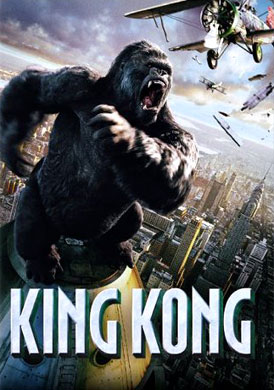
Monster Movie of the Week: King Kong (2005)


KING KONG (2005)
Director: Peter Jackson
Genre: Adventure/Tearjerker

THE MOVIE:


King Kong has been around the block a few times. He starred in the classic 1933 movie and its sequel, a couple of Japanese movies (including one in which he fought Godzilla and in another he fights Mechanikong) and a 1976 remake and its sequel. And let’s not forget all of the giant ape copycat movies that Kong inspired. One could have been forgiven for thinking that the 2005 remake was less than necessary (especially after the disappointing Godzilla remake in 1998).However, when you have a filmmaker like Peter Jackson-who was at the height of his creative powers having just finished the Lord of the Rings Trilogy-it changes the equation a bit.


The most important factor was that Peter Jackson absolutely loves and respects the original 1933 movie. One has to only see the extras on the DVD of the original King Kong in which Jackson painstakingly recreates the lost Spider Pit sequence using only 30’s era technology. You can clearly see that this is the lucky guy who loves what he is doing.Again, I have to go back to Emerlich and Devlin’s Godzilla remake. Here were two guys who were given a brand and were told they could do what they wanted with it. They had no particular love or interest in the original series and decided to do a remake that had almost nothing to do with the original Godzilla movies. In contrast, Jackson took the original movie, knew there were things he could do to better realize it, and made a movie that might have been very similar to what the original filmmakers would have done if they had the 2005 technology at their disposal.We all know the story of Kong. We all know how it ends. But what really works in this version is the relationship between Anne Darrow (Naomi Watts) and Kong (mo-cap by Andy Sirkis, who did similar duty on Gollum in the Lord of the Rings movies.) Really, the whole movie hinges on this relationship. In past versions of the story there is an element that is, shall we say…creepy…about this pairing. I think the previous versions of Kong have been informed by an idea that he represents a sort of primitive Third-World sexuality focused on this white blond woman, whereas, Peter Jackson’s Kong behaves more like a real gorilla. He is presented as being isolated on Skull Island and is the last of his kind in a hostile environment. Anne is equally isolated and afraid to reach out to anyone. The fact that these two are able to form such an important connection is very beautiful and touching and gives the movie its center, and makes this version of King Kong the great unconventional love story it was always meant to be. Respect for Watts and Sirkis for being able to bring this relationship to the forefront despite several layers of technology. Peter Jackson once again shows that he can make a big budget special effects movie that focuses on character, relationships and emotion.

THE MONSTER/EFFECTS:

The greatest special effects application is the use of motion capture which allows Kong to be inhabited by actor Andy Sirkis resulting in an actual performance and not just an animation. This is part of the reason that the film is so successful and heartbreaking because you really feel invested in Kong as a character and not a guy in a monkey suit, a stop motion puppet, or a giant animatronic head.


There are a lot of special effects in this movie, from the obvious creature effects to the more subtle effects used to create or enhance environments. There’s nothing necessarily groundbreaking but all the effects are well executed.

MONSTERS FEATURED:

Skull Island is crawling with monsters. There are dozens of dinosaurs, from T-Rex and Raptor analogues to larger sauropods. There are bugs galore, including giant man-eating wetas. There are some creatures that defy description such as one that I can only call the “Foreskin monster.”

Much like James Cameron's Avatar four years later, King Kong attempts to create an ecosystem (although an impossible one; Skull Island would have to be huge to support all of those dinosaurs). There is even a great companion book to the movie, The World of Kong: A Natural History of Skull Island, which is book of concept art for the movie disguised as a guide book to the flora and fauna of the island. The main idea behind Jackson's concept for Skull Island is that it is a place where prehistoric animals never went extinct and continued to evolve for the last 65 million years, so they are not exactly as we know them from the fossil record (hence the V-Rex being slightly different from its extinct ancestors).

MOST MEMORABLE SEQUENCE:

V-Rex Fight. Kong fights three V-Rexes, on a cliff, suspended on vines and on the ground, mostly while holding on to Anne. And the absolutely heartbreaking end of the movie.

DVD AVAILABILITY:

There have been several releases on DVD. The Extended Edition restores about 22 minutes of footage, including the river raft sequence that features an giant fish that resembles Giger’s Alien more than a little bit. Although, the movie does take its time getting going so the extra 22 minutes might be a dealbreaker for some people. There are plenty of other documentaries and extras.

Most, if not all, of these features are available on the Bluray version of the movie, which features both the theatrical and extended cuts. Like many Blurays, the featurettes and other supplemental materials are only available as branching features while watching the movie. What the hell is up with that anyway?

SEQUELS:

None planned or needed.

SEE ALSO:

King Kong* (1933), King Kong (1976)

TRAILER:


*The 2005 Collector’s Edition of the 1933 movie features extensive interviews with Peter Jackson in which he talks about his love for the movie. It also features a very interesting documentary in which Jackson’s 2005 Kong crew attempts to recreate the infamous and lost “Spider Pit” sequence using technology available in the 30’s. The documentary takes you through the whole process and you get to see the final recreation of that scene.

Monday, April 19, 2010

MONSTER MOVIE OF THE WEEK: DEEP BLUE SEA (1999)

This summary is not available. Please click here to view the post.