Showing posts with label Urban Destruction. Show all posts

Saturday, April 24, 2010

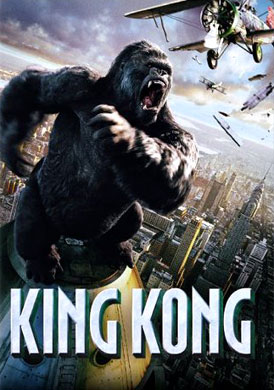
Monster Movie of the Week: King Kong (2005)


KING KONG (2005)
Director: Peter Jackson
Genre: Adventure/Tearjerker

THE MOVIE:


King Kong has been around the block a few times. He starred in the classic 1933 movie and its sequel, a couple of Japanese movies (including one in which he fought Godzilla and in another he fights Mechanikong) and a 1976 remake and its sequel. And let’s not forget all of the giant ape copycat movies that Kong inspired. One could have been forgiven for thinking that the 2005 remake was less than necessary (especially after the disappointing Godzilla remake in 1998).However, when you have a filmmaker like Peter Jackson-who was at the height of his creative powers having just finished the Lord of the Rings Trilogy-it changes the equation a bit.


The most important factor was that Peter Jackson absolutely loves and respects the original 1933 movie. One has to only see the extras on the DVD of the original King Kong in which Jackson painstakingly recreates the lost Spider Pit sequence using only 30’s era technology. You can clearly see that this is the lucky guy who loves what he is doing.Again, I have to go back to Emerlich and Devlin’s Godzilla remake. Here were two guys who were given a brand and were told they could do what they wanted with it. They had no particular love or interest in the original series and decided to do a remake that had almost nothing to do with the original Godzilla movies. In contrast, Jackson took the original movie, knew there were things he could do to better realize it, and made a movie that might have been very similar to what the original filmmakers would have done if they had the 2005 technology at their disposal.We all know the story of Kong. We all know how it ends. But what really works in this version is the relationship between Anne Darrow (Naomi Watts) and Kong (mo-cap by Andy Sirkis, who did similar duty on Gollum in the Lord of the Rings movies.) Really, the whole movie hinges on this relationship. In past versions of the story there is an element that is, shall we say…creepy…about this pairing. I think the previous versions of Kong have been informed by an idea that he represents a sort of primitive Third-World sexuality focused on this white blond woman, whereas, Peter Jackson’s Kong behaves more like a real gorilla. He is presented as being isolated on Skull Island and is the last of his kind in a hostile environment. Anne is equally isolated and afraid to reach out to anyone. The fact that these two are able to form such an important connection is very beautiful and touching and gives the movie its center, and makes this version of King Kong the great unconventional love story it was always meant to be. Respect for Watts and Sirkis for being able to bring this relationship to the forefront despite several layers of technology. Peter Jackson once again shows that he can make a big budget special effects movie that focuses on character, relationships and emotion.

THE MONSTER/EFFECTS:

The greatest special effects application is the use of motion capture which allows Kong to be inhabited by actor Andy Sirkis resulting in an actual performance and not just an animation. This is part of the reason that the film is so successful and heartbreaking because you really feel invested in Kong as a character and not a guy in a monkey suit, a stop motion puppet, or a giant animatronic head.


There are a lot of special effects in this movie, from the obvious creature effects to the more subtle effects used to create or enhance environments. There’s nothing necessarily groundbreaking but all the effects are well executed.

MONSTERS FEATURED:

Skull Island is crawling with monsters. There are dozens of dinosaurs, from T-Rex and Raptor analogues to larger sauropods. There are bugs galore, including giant man-eating wetas. There are some creatures that defy description such as one that I can only call the “Foreskin monster.”

Much like James Cameron's Avatar four years later, King Kong attempts to create an ecosystem (although an impossible one; Skull Island would have to be huge to support all of those dinosaurs). There is even a great companion book to the movie, The World of Kong: A Natural History of Skull Island, which is book of concept art for the movie disguised as a guide book to the flora and fauna of the island. The main idea behind Jackson's concept for Skull Island is that it is a place where prehistoric animals never went extinct and continued to evolve for the last 65 million years, so they are not exactly as we know them from the fossil record (hence the V-Rex being slightly different from its extinct ancestors).

MOST MEMORABLE SEQUENCE:

V-Rex Fight. Kong fights three V-Rexes, on a cliff, suspended on vines and on the ground, mostly while holding on to Anne. And the absolutely heartbreaking end of the movie.

DVD AVAILABILITY:

There have been several releases on DVD. The Extended Edition restores about 22 minutes of footage, including the river raft sequence that features an giant fish that resembles Giger’s Alien more than a little bit. Although, the movie does take its time getting going so the extra 22 minutes might be a dealbreaker for some people. There are plenty of other documentaries and extras.

Most, if not all, of these features are available on the Bluray version of the movie, which features both the theatrical and extended cuts. Like many Blurays, the featurettes and other supplemental materials are only available as branching features while watching the movie. What the hell is up with that anyway?

SEQUELS:

None planned or needed.

SEE ALSO:

King Kong* (1933), King Kong (1976)

TRAILER:


*The 2005 Collector’s Edition of the 1933 movie features extensive interviews with Peter Jackson in which he talks about his love for the movie. It also features a very interesting documentary in which Jackson’s 2005 Kong crew attempts to recreate the infamous and lost “Spider Pit” sequence using technology available in the 30’s. The documentary takes you through the whole process and you get to see the final recreation of that scene.

Wednesday, October 7, 2009

Monster Movie of the Week: CLOVERFIELD (2008)


Cloverfield (2008)

Director: Matt Reeves

Genre: Monster on the Loose, Ameri-kaiju


THE MOVIE


Cloverfield might have been the victim of its own wildly successful marketing campaign. The trailer for Cloverfield came out of nowhere, attached to 2007’s megahit Transformers and it gave almost no information about the movie whatsoever. Not even the title.


And people went nuts. Speculation on the internet raged. People analyzed every little bit of information parsed out in the various viral websites and games associated with the movie. Was it a new Godzilla movie? Was it a Voltron movie? (“It’s a lion! It's huge!”) Was it an American Gamera movie? A Lost movie? What it actually was, was an attempt to create an iconic American movie monster that could stand with Godzilla.


While it remains to be seen if Cloverfield will have any kind of staying power in the American popular consciousness (anyone watch The Blair Witch Project recently? Didn’t think so.), it is an undeniably compelling experience and a unique take on the giant monster genre. While Cloverfield has its roots in Japanese kaiju movies, it avoids the mistakes usually made by American attempts to adapt the genre (see 1998’s Godzilla). The monster is kept largely mysterious; there are no long-winded attempts to explain anything. There are no talking-head scientists or feisty girl reporters to provide the characteristic loopy exposition that manages to be endearing the Japanese kaiju movies and grating in American ones.


"I said no cameras!"

The movie effectively asks and answers the question “What would a giant monster attack really be like?” Because of the first-person point-of-view, we are literally with the human characters the whole time. More often than not, in kaiju movies, we are “with” the monster for much of the movie. If not in his point of view, we are at treating him as a character and seeing things more or less from his perspective. Here, we never are seeing things from his perspective, and he is only a force of destruction, which we are unfortunate enough to witness on several occasions.


The monster’s attack on Manhattan is presented as a terrible and shocking event that can’t help but recall the 911 attacks. This is really the first post-911 giant monster movie and the filmmakers exploit these new phobic pressure points to good effect. Despite it’s first-person conceit, this movie has quite a bit in common with the original Japanese Godzilla movie. Both movies were produced in the aftermath of some horrible traumatic national event, in Japan, the atomic bombings of Hiroshima and Nagasaki. Both are presented in a serious, realistic fashion. Both cinematic events are confused with the above events.


Yes, this thing is the Cloverfield monster. Well, Hasbro's interpretation.

THE MONSTER/EFFECTS


The monster in Cloverfield is for me a bit of a let down. He’s not really a cohesive creature but a collection of disparate animal parts that don’t go well together. With his fragile-looking forelimbs and weird bat-like head (which recalls the Ray Harryhousen’s Ymir creature), he’s not particularly tough-looking by monster standards and he looks like he would lose in a fight against Godzilla, Gamera or even the American Zilla. Most importantly, the Cloverfield monster lacks personality in his brief screen time.


MONSTERS PRESENT


The monster, “Clover”

Numerous dog-sized parasites.


MOST MEMORABLE SEQUENCE


Actually, featured in the trailer, the initial moments of the monsters attack on the city culminating in the rolling head of the Statue of Liberty.


DVD AVAILABILITY


Widely available on DVD and Blu-Ray, although really what is the point of having this movie on Blu-Ray since it was filmed with consumer video?


God sends his vengeance against yuppie hipsters.


THE TRAILER


SEE ALSO

Gojira 1954, The Beast from 20,000 Fathoms 1953, Godzilla 1998


TRIVIA


Technically, this is not the first kaiju story to be told in first person. That honor belongs to an episode of Godzilla: The Series, the animated series that serves as the sequel the American Godzilla movie. The show somehow manages to be a lot better than the movie and far more true to the Japanese series of Godzilla movies.


Saturday, October 3, 2009

Bonus Monster Movie of the Week: Gojira (1954)


GOJIRA* (1954)

Directed by: Ichiro Honda
Genre: Daikaiju eiga

THE MOVIE:

When you think of Godzilla, chances are that you picture a big goofy looking rubber dinosaur grappling with a colorful and silly opponent. Unfortunately, most people’s conceptions of the King of the Monsters are rooted in the kid-friendly and badly-dubbed Technicolor movies of the late 60’s and early 70’s when the series had sunk irrevocably into camp. Because of this, most people are surprised by the tone of the original Japanese Gojira which is an urgent and somber meditation on the dangers of nuclear testing and scientific advancement. To a Japanese audience, only nine years after Hiroshima and Nagasaki this must have been powerful stuff.

However, not necessarily original stuff: Gojira was released only a year after The Beast from 20,000 Fathoms, an American movie which also featured a giant saurian creature woken by atomic testing which goes on a rampage through a major city. Because of Japan’s legacy as the world’s sole atomic victim, there is an urgency and horror to the material in Japanese hands that’s not there in The Beast as though Gojira is the feverish nightmare of someone who experienced the aftermath of nuclear holocaust. This context is what makes Gojira more than just another radioactive monster movie and gives the film a richness and resonance that it wouldn’t otherwise have.


Another interesting element present in Gojira that is absent from the re-edited American version is a level of ambivalence about Japan’s relationship with America. It seems that the direct inspiration for the movie was a 1953 incident in which American nuclear weapons were tested in Japanese waters and the crew of a Japanese fishing boat became ill from radiation poisoning. This incident is actually directly referred to in the Japanese version of the movie but cut from the U.S. version to make it friendlier to American audiences. Thus, in the Japanese version of the movie, the blame for Godzilla is laid directly on America. There is a symbolic framework in place that makes Godzilla a symbol of U.S. (possibly and or Soviet) power in the world. In this sense, Gojira is a direct ideological ancestor of the 2006 South Korean film, The Host, another film that features a monstrous result of America’s policies in Asia. However, in the case of Gojira this might be overly simplistic. Another way to interpret the movie would be that Godzilla is visited on Japan as punishment for its aggression during the Second World War. It seems that Gojira may involve a bit of self-flagellation. Japan’s relationship with its wartime past is very complicated and they seem to feel simultaneously proud and guilty for their activities during World War II.

Ultimately, Japan’s relationship with Godzilla is very complicated. Per the film, he is literally created by American nuclear testing. But the monster doesn’t go to LA or San Francisco to punish the Americans, he goes straight to Tokyo and completely destroys the city, leaving it as though a bomb were dropped on it. He punishes the Japanese. Over the years in Japanese cinema, Tokyo and other cities are destroyed over and over again. Why do the Japanese seem to enjoy seeing their cities destroyed so much? I wonder how these movies play in neighboring Asian countries that were Japanese occupied during the war. How do the Chinese feel seeing giant monsters destroying Japan? I mean, we have our big explosions and disaster movies as well but it is not as much a fetish for American moviemakers to show this level of meticulous urban destruction. In Godzilla, the Japanese are simultaneously punishing themselves and revisiting their nuclear victimization which is why Godzilla is so potent as a monster and a symbol.

THE MONSTER/EFFECTS:

Gojira pioneered the use of “suitmation,” what Toho Studio calls the combination of rubber suit acting combined with detailed miniature sets. It has since been a staple of Toho’s Godzilla series and one they have been adamant about maintaining even in this age of high tech digital effects.

This was the first of many variations of the Godzilla costume and this one is perhaps a little more dinosaur-like than some of the later suits. It has a larger head than we are used to seeing in the modern Godzilla movies and due to the overall darkness of the film the suit serves nicely in this movie.

MONSTERS FEATURED:

This, along with Godzilla, (1984) and the American Godzilla (1998) are the only films in the series to feature Godzilla without another monster opponent.

MOST MEMORABLE SEQUENCE:

Godzilla’s chilling nocturnal rampage through Tokyo.

HOME VIDEO AVAILABILITY:

Although the American Godzilla: King of the Monsters has been available on DVD for years, the original Japanese version was unreleased in the U.S. until 2006 when the two disc set Gojira was released featuring both versions of the movie with some documentaries.

The movie is also available on Bluray.


SEQUELS:

There are currently about twenty nine movies in the Godzilla series. This one was immediately followed by:

Godzilla Raids Again (1955), King Kong Vs, Godzilla (1962) and Godzilla Vs. Mothra (1964.)

The movie was also very loosely remade in the United States in 1998 and set for a new American version in 2012.

SEE ALSO:

The Beast from 20,000 Fathoms (1953)
Godzilla Vs. Mothra (1964)
Godzilla Vs. King Ghidorah (1991)
Godzilla, Mothra, King Ghidorah: Giant Monsters All Out Attack (2001)
The Host (2006)

THE TRAILER:


TRIVIA:

Godzilla was originally to be realized as a stop-motion creature like the ’33 King Kong or the Rhedosaurus from The Beast from 20,000 Fathoms but Toho Studios lacked the budget and expertise to do this so they opted to go the rubber suit method. Can you imagine how cool a stop motion Godzilla would have been?

*In Japanese, “zee” actually sounds more like “dzjee” so “Gojira” actually becomes “Godzjeera” hence the anglicized Godzilla.

Thursday, September 24, 2009

Monster Movie of the Week: King Kong (1976)

It takes a set of Kong-sized nuts to bill your remake as "the most exciting original motion picture event of all time!"


King Kong (1976)

Director: John Guillermin

Genre: Monster on the loose


THE MOVIE


Blockbuster fever struck American movie goers in the mid seventies. After the runaway success of Steven Spielberg’s Jaws in the summer of 1975, movie studios began clamoring for the next big event movie. What better event movie than a remake of a story that is synonymous with the word “big?”


The 1976 remake of King Kong is interesting to watch if only to see how it is different and similar from the other two major versions of the story. The ’76 Kong differs greatly from both the ’33 and ’05 movies. This version of the story is the least spectacular and the most sexually charged. This is also the least regarded of the Kong movies and is often thought of as a turkey or a bomb although it was actually a big hit upon its release but not in the ballpark of Jaws which is certainly what it was hyped for.


The movie follows the basic storyline of the original, although in this version the film crew is replaced by an oil expedition (remember this was during the first Energy Crisis) headed by a Fred Wilson (Charles Grodin,) a Nixonian paranoiac who has staked his reputation on finding oil beneath Skull Island. Jack Prescott (Jeff Bridges) stows away on the boat. In this version, he is a primatologist who has heard stories of giant apes on Skull Island.


Once at sea, the crew finds Dwan (Jessica Lange) floating in a lifeboat. Dwan switched the middle two letters of her name so that it would be more memorable. Dwan is an actress who was aboard a luxury liner that exploded For Some Reason. Dwan is, as a friend of mine once succinctly put, "Actress-Crazy." This is very special combination of insecure, flightly, neurotic, self-absorbed and plain ole' nuts that only a working actress can really pull off (for a great example of Actress-Crazy see Terry Garr in Tootsie). Jessica Lange plays Dwan like she’s constantly horny or high (sometimes she combines them to mix it up.) Sometime between this movie and her appearance in (yes) Tootsie she became a very good actress but her performance in King Kong is total camp.


The other main departure from the classic story is that that this Skull Island is not inhabited by all of the dinosaurs and strange creatures that we have come to expect. It is inhabited by Kong and a large rubber snake and a bunch of Africans (despite the fact that it is in the South Pacific). So, some of the fun of the original and Peter Jackson version are lost here.


When they get to New York the story pretty much matches the other versions, only here Kong climbs the then newly-constructed World Trade Center Towers instead of the Empire State Building, as he does in the other versions. I always find World Trade Center scenes a little distracting in movies filmed before 9/11. Unfortunately, most movies filmed in New York from the 70’s through the 90’s feature the buildings prominently. King Kong features some gratuitous WTC action.


THE MONSTERS/EFFECTS


This Kong is not realized with stop motion as the original was but with a mix of suitmation and animatronics and the final result looks strangely Fonzie-esque. While the animatronic masks are capable of a large range of movement and expression, the effect is usually just creepy, especially when Kong leers at Jessica Lange’s character constantly. Or the scene where he blows repeated on a wet Dwan, which is just wrong. Wrong and disturbing.


This has to be the perviest Kong yet. The sexual subtext of the original is here brought closer to the fore (“He tried to rape you!” says Charles Grodin’s character) and it loans the movie a lurid and unpleasant quality. The Peter Jackson version is smart enough to diffuse the sexual aspect all together and build a genuine connection between Anne and Kong. This one is not.


Squish.


MOST MEMORABLE SEQUENCE


This is the only version of the story to depict Kong’s actual trip to New York. I've always wondered what that trip must have been like. I like the scenes where he is locked up in the bowels of an oil tanker pounding the hell out of it.


SEQUELS


King Kong Lives 1986


DVD AVAILABILITY

Widely available in a bare-bones DVD.


SEE ALSO


King Kong 1933 King Kong Escapes 1967 King Kong 2005


TRIVIA


This movie represents a slightly larger version of Kong than is usually depicted in the American movies. Here, he is described as being about 50 feet tall whereas normally he is about 25-30 feet tall.

The Japanese Kong is on a much larger scale allowing him to tangle with the likes of Godzilla.


Thursday, September 17, 2009

Monster Movie of the Week: Mothra (1961)

Warning: Staring at Japanese movie posters for extended periods may induce a seizure.


MOTHRA (1961)

Director: Ichiro Honda

Genre: Daikaiju eiga


THE MOVIE


Mothra ushered in a short-lived Golden Age of 1960’s kaiju filmmaking in which the norm became high production values and colorful visuals before the genre sank into camp and kiddie nonsense . Mothra is the best of the three non-Godzilla kaiju movies produced by Toho in the wake of Godzilla Raids Again and also introduced us to one of Toho’s most iconic and popular monsters. Mothra has been featured in more Toho movies than any other monster save the big guy himself and is even popular enough to have starred in her own trilogy of kids films in the 1990’s. Her popularity (particularly with the ladies) has caused her to be plugged into numerous Godzilla movies in which she was not originally slated to appear. She’s one of the few female Japanese giant monsters and one of the only ones that is consistently benevolent and she’s the only kaiju with a catchy theme song sung by a pair of mini-twins.


Mothra's story borrows heavily from King Kong and deals with a joint expedition between Japan and a fictitious country (that strongly resembles the U.S.) to the mysterious Infant Island that is home to a tribe of natives and also the site of atomic testing. Once on the island, one of the Japanese expedition members is saved by a pair of tiny singing twins. The twins are stolen from the island by an unscrupulous member of the foreign party and put in a musical revue a la Kong's Broadway show. My question is: how the hell are you supposed to see them from the audience? I don’t think a stage show is quite the right venue for six inch singing twins. And how did they get them to rehearse elaborate musical numbers?


Anyhoo, the twins launch into their chart-topper “Mo-su-ra” and a giant silkworm hatches from a pastel colored egg and swims towards Tokyo, impervious to all weapons. The larva climbs up Tokyo Tower and breaks it in half before spinning a silken cocoon. What hatches is perhaps the most improbable of a giant monster designs: a big pretty butterfly. Perhaps the Japanese Defense Force would have fared better against her if they had built a giant net. So, Mo-su-ra follows the twins to New Kirk City (NKC!) and eventually reclaims her twins (does she swallow them? I’m not clear on where they “boarded”) after blowing stuff around with her wings.


Why even have a Tokyo Tower?


THE MONSTER/EFFECTS


It takes a real man to be a Mothra fan. Her femininity, her colorful appearance, her harmonizing sidekicks all elicit a derisive reaction from kaiju mandom. I mean, a guy can get away with wearing a Godzilla t-shirt, no problem but if you walk around with a Mothra shirt you better watch your back. If you are not entirely comfortable with your masculinity, the idea of a giant ass-kicking psychedelic butterfly nature goddess may be somewhat disturbing for you. Although the somewhat fecal appearance of the larva will be good for a chuckle from the guys.


The effects in Mothra are surprisingly good for the time and are certainly better than any of Toho’s prior kaiju movies. I am very surprised and happy to say that there is very little Rodanitis present in the flying sequences. Mothra’s wings move in a very realistic and even elegant way. The wirework and other mechanisms are for the most part well-concealed. I can only speculate that more of the budget was devoted to the flying sequences since there were only two creatures to design for this one.


MONSTERS PRESENT


Mothra in both her larval and adult form.


DVD AVAILABILITY


This one’s a little hard to get. I managed to buy a copy of the Japanese version from ultramanstuff.com. There’s not much else on the disc and the video is not excellent but at least it’s the Japanese version. As with the other disc I bought from them it took a long time and a couple of check up emails before I got my disc but I got it. I don’t know what changes or cuts were made to the American version.


MOST MEMORABLE SEQUENCE


The larva’s attack on Tokyo Tower.


SEQUELS


Some say the world will end in fire others...by giant stuffed animals.


Mothra is featured in quite a few of the Godzilla movies but as far as I know the only true sequel is Godzilla X Mechagodzilla: Tokyo S.O.S. (2003) which directly refers to the original Mothra movie and even features one of the actors reprising his Mothra role some forty years later, which is kind of cool.


SEE ALSO


Godzilla vs. Mothra (1964) Godzilla vs. Mothra (1992) Rebirth of Mothra I-III (1996) Godzilla: Final Wars (2004)


Sunday, September 13, 2009

Bonus Monster Movie of the Week: King Kong (1933)


KING KONG (1933)
Director: Merian C. Cooper
Genre: Monster on the loose/Adventure/Lost World

THE MOVIE

King Kong is probably the most important in influential monster movie of all time. It spawned a whole genre of giant monster movies and a slew of imitators and copycats as well as one direct sequel, two official big-budget remakes and a short lived Japanese series from Toho studios. It was one of the first big “special effects” movies. Kong’s influence even reaches into far-flung and unexpected places. For example, King Kong was an obvious inspiration for the classic video game Donkey Kong which in turn spawned Super Mario Brothers and the whole series of classic video games that followed. In fact, Kong was so popular in Japan that he receives billing over Japan’s own signature monster in King Kong vs. Godzilla, not to mention that he is the ultimate victor at the end of the movie.

Although the story of Kong was created for the movies, its roots go far back to the “Lost World” stories that became popular in the Victorian era. These stories were created as a response to the discoveries of dinosaur fossils that captured the imagination of the world. It featured the requisite distant tropical island that was the last haven for a population of extinct animals such as dinosaurs and giant bugs. King Kong is also a spin on the beauty and the beast theme in which a beautiful woman is kept and grows an attachment to a monstrous male. These elements were mixed together and turned into something fresh for this (at the time) new medium.

King Kong actually started out as something closer to Arthur Conan Doyle’s The Lost World and Edgar Rice Burroughs’ The Land that Time Forgot in which a ship is stranded on a prehistoric island. This film was to be called Creation and it was the brain child of special effects director Willis O’Brien. Creation was never finished but the special effects convinced Merian Cooper that this genre could be done well on film. In fact, many elements from Creation (and many of the dinosaur models) were later used for Kong.

THE MONSTER/EFFECTS

Kong is probably the most famous movie monster of all time and in his first appearance he is realized through stop-motion animation. One of the great successes of the movie is that Willis O’Brien manages to get a genuine performance out of his little articulated doll. Like any truly memorable screen monster, Kong is more than just an animal. In his first incarnation he begins the long trek towards becoming a truly tragic antihero that comes to fruition in Peter Jackson’s 2005 remake. Unfortunately, there is too much going on in the filmmaker’s 1933 point of view that keeps that from really happening here. This has primarily to do with an unpleasant racial subtext and silly ideas about gorilla behavior. This was a time when people still thought that gorillas were carnivorous and that they would kidnap and rape women, hence Kong’s creepy stripping of Anne’s dress in the movie.

The extent and use of effects in this movie are truly revolutionary and may not be apparent at first glance to a Twenty-First Century viewer. They go beyond simply the animation of the many creatures in the movie and many of them are “invisible” effects that serve to cleverly and seamless composite the animation and live action together. Many of the effects serve to expand and deepen the lush jungles on Skull Island. Unlike today, this was all done optically and in camera using matte paintings as backgrounds and several layers of paintings created on glass to give a sense of depth to the jungle environment. Again, we look at it now and don’t notice it because we take it for granted but the special effects in the original King Kong are incredibly sophisticated and the artists who worked on this movie deserve eternal respect for their contributions to movie making.

DVD AVAILABILITY


This movie is widely available in several versions but I strongly suggest getting a copy of the deluxe two-disc edition which is loaded with bonus material befitting this classic movie.

MOST MEMORABLE SEQUENCE


My most memorable sequence is actually not in the move but in the extras. One of the nice things about the extras is that Peter Jackson is involved in some of the documentaries talking about his love for the original movie as he was in preproduction for his remake at the time. He even shows off some of his collection of Kong memorabilia such as one of the original stop motion models.

I’m getting ahead of myself. Let’s back up. There is an infamous lost sequence from King Kong. When the sailors are shaken off the log the fall into a pit filled with giant spiders and other bugs. This sequence is referred to as the Lost Spider Pit Sequence and is analogous to the scene in Jackson’s remake. The scene was filmed for the original movie but cut at some point prior to the movie’s release either because it was too horrific or perhaps only for pacing reasons. All that exists from this scene are some still photos and the original models (some of which were featured in The Black Scorpion.)


So there is this very intriguing idea that somewhere in the world in some vault there may be a famous lost scene from King Kong. Or maybe it was tossed in the incinerator. Re-enter Peter Jackson, who has been semi-obsessed with this scene since he was a young man. What Jackson and his people at WETA did for this Kong DVD was to take all of the original designs that exist from the Spider Pit sequence and rebuild them, animate them and film them using 1933 technology to recreate what this lost sequence would have looked like to the best of their ability. It is not edited into the movie but is available as part of a documentary in the extras. This is just cool on so many levels.

SEQUELS

Son of Kong (1934)

MINORITY REPORT


Where to begin with what’s messed up with King Kong? A bunch of white Americans come on a boat to some island in the Pacific inexplicably filled with African “savages” who worship a giant horny gorilla that is obsessed with a blond white woman. This may be the origin of the term “jungle fever.” I guess the main thing is that the movie propagates a generic and Eurocentric idea about “primitive” people. What’s even worse is that most people who have seen the movie are so accustomed to these jungle stereotypes that they will not stop to think about how condescending and offensive they are. Africa (and other naturally rich but underdeveloped places) were often depicted in old movies as an exotic and dangerous background for an adventure story whose people happened to be servants or adversaries of the white protagonists. King Kong is a great movie but it is definitely a product of early Twentieth Century American thoughts and attitudes.

THE TRAILER:


SEE ALSO:


The remakes from 1976 and 2005.

Friday, September 11, 2009

Monster Movie of the Week: 20 Million Miles to Earth


"Out-of-Space?" So, it's mad because it doesn't have enough closet space?

20 MILLION MILES TO EARTH (1957)


Director: Nathan Juran

Genre: Monster on the loose


THE MOVIE:


Back in the day, moviemakers could get away with silly science fiction premises like “In the year 1974, man has colonized the sun….” The premise of the classic 20 Million Miles to Earth is that a manned expedition to the surface of Venus crash lands in the Mediterranean and looses a Venusian monster on Rome. In reality the surface of Venus is hot enough to melt lead. Oh well, ignorance was bliss, or at least the fodder for fun movies like this one.


In the year 1957 man has secretly landed on Venus. The ship crashes to earth with only one human survivor. A canister containing a specimen of Venusian life looses itself from the ship and washes on to the Italian shore. A young boy finds it and sells it to a local zoologist. The little beast feeds off of sulfur and grows to enormous size. The zoologist attempts to take it to Rome but the beast escapes and goes on a mini rampage before it is recaptured. The creature again escapes and goes on a larger rampage in Rome, battling an elephant in the process.


This is another one of the movies worked on by the brilliant special effects master Ray Harrryhousen, the undisputed master of stop motion creature effects, having studied under the great King Kong special effects artist Willis O’Brian. His work on 20 Million Miles to Earth is among his best. It is also a great example of the monster-on-the-loose subgenre of movies which featured monsters running amok in urban settings, a favorite theme of the Harryhousen movies.


THE MONSTER/EFFECTS


The monster is known as the Ymir, although this term is never used in the movie. He grows to a height of about 25ft and is a bipedal reptile with a human like torso and a long tail. His face resembles that of the Creature from the Black Lagoon, or, much later, the Cloverfield monster. Like the earlier Harryhousen film, The Beast from 20,000 Fathoms, this film is shot in glorious black and white and the lighting is again used here to give the Ymir a wonderful three-dimensionality and texture. Harryhousen animates the creature with great personality and realism, such as the scene early on when the miniature version of the Ymir is first exposed to light and covers its eyes in a way that is almost cute. Ultimately, this is a sympathetic creature that has been displaced from its own home and thrown into our world by human beings. There are some other nice allusions to King Kong throughout the movie, such as the building top climax, here taking place at the ruins of the Coliseum instead of the Empire State Building.


MONSTERS FEATURED


Only the Ymir.

Grandpa?


MOST MEMORABLE SEQUENCE


The monster rampaging through Rome with the Imperial Ruins as a backdrop.


Now in groovy vision!


DVD AVAILABILITY


The original version of the movie has long been available and includes a nice Harryhousen retrospective and a few other features.


Recently a special edition came available featuring a new colorized version of the movie supervised by Harryhousen himself (apparently they wanted to shoot in color but did not have the budget) as well as the original black and white version.


THE TRAILER:


SEE ALSO:


The Beast from 20,000 Fathoms (1953) King Kong (1933)

Saturday, August 22, 2009

Bonus Monster Movie of the Week: The Beast From 20,000 Fathoms (1953)


THE BEAST FROM 20,000 FATHOMS (1953)

Director: Eugene Lourie
Genre: Monster on the loose, proto-daikaiju movie.

THE MOVIE:

You may not have seen The Beast from 20,000 Fathoms but it is without a doubt one of the most influential genre movies of the 1950’s and beyond. If it seems like a fairly typical 1950’s monster movie (A giant prehistoric creature is awakened by atomic testing at a remote location while bland characters try to find a way to stop it as it wreaks havoc on the nearest big city) that is because it was copied over and over again. It also has an interesting but under-developed subplot about the dinosaur carrying a virulent disease.

Typical alarmist Liberal Media.

Lourie’s was later followed by such movies as Them! (1954) and It Came from Beneath the Sea (1955.) The Beast actually resembles another seminal monster movie: Gojira, or Godzilla: King of the Monsters, (1954) as the Americanized version of the original film was known. The Beast from 20,000 Fathoms is actually the midpoint between King Kong and the original Godzilla series. Like King Kong it uses stop-motion technology to bring the story of a monster terrorizing New York to life. Like Gojira the monster is saurian and is the result of atomic testing.

One could actually make the case that the American Godzilla (1998) was in fact more of a remake of The Beast from 20,000 Fathoms than Gojira. Its creature is far more like the Rhedosaur in nature than Toho’s Godzilla. And the American Godzilla’s landing in New York is almost identical the Rhedosaur’s arrival in The Beast. There are several other shots in the Godzilla remake that seem to intentionally pay homage to The Beast from 20000 Fathoms. Maybe they should have just remade that movie instead.

THE MONSTER/EFFECTS:

The Rhedosaurus effects are accomplished though some very nice stop motion courtesy of the great Ray Harryhousen and some truly crappy hand puppet work for close ups. I was really surprised by how good the creature looked in most of his shots. Its nice to see that in the twenty years since the original King Kong the stop motion techniques were refined to a kind of high art form. The Rhedosaur has a wonderful three dimensionality and texture under the lights and is well integrated into the backgrounds.

New York is a great city...for me to poop on!!

This particular dinosaur is not your usual T-Rex or Allosaurus clone but an invented quadrupedal carnivorous creature. It resembles the animals that Naomi Watts stumbles upon in Peter Jackson’s King Kong (2005) which later chase her into a rotting log before getting munched on by a bigger dino. The Rhedosaur is ike that, but much bigger.

MONSTERS FEATURED:

The Rhedosaurus and some stock footage ocean life.

The Rhedosaur, terrorizing Ralph Kramden's apartment building.

MOST MEMORABLE SEQUENCE:

There are actually quite a few, from the famous attack on the lighthouse to the creature’s entrapment in a Coney Island roller coaster.

DVD AVAILABILITY:

It is available on it’s own with a nice little documentary featuring an interview with Harryhousen and some trailers or in a two-pack with Them!

SEQUELS:

None.

"Where Brooklyn at?"

THE TRAILER:


SEE ALSO

Gojira (1954), King Kong (1933), Godzilla (1998)