Showing posts with label Damn Dirty Apes. Show all posts

Tuesday, December 6, 2011

Monster Movie of the Week: Conquest of the Planet of the Apes (1972)


Conquest of the Planet of the Apes (1972)
Directed by J. Lee Thompson
Genre: Socio-Science Fiction

THE MOVIE

The second sequel to Planet of the Apes is a striking about-face from its immediate predecessor, the mostly light-hearted Escape from the Planet of the Apes. Conquest is the darkest and most violent of the Apes movies and is very much a product of the gritty early seventies, the heyday of violent exploitation movies.

Chronologically, Conquest takes place twenty years after Escape and tells the pivotal story of how the Apes took over the Earth, portraying the early events of the world we see in the original movie. In a bit of early '70's futurism, the movie is set in a spare and sleek 1991. In this future, America has become a dysutopian society that is reliant on the slave labor of (genetically engineered?) apes. These apes are mute and beat down, not unlike the humans in the first movie.

The rather flimsy back story for the apes is that there had been a plague that killed off the earth's population of dogs and cats. Apes were brought in as replacements (!) and ultimately they were trained to work menial tasks and hard labor. Humans eventually began to rely on them so heavily that the apes became a cornerstone of the economy.


Meanwhile, Cornelius and Zera's child, Ceasar, had been raised in secret by the circus owner, Armando. For most of Ceasar's life, he has been hidden from the authorities who believed that they had killed the child of the talking apes and safeguarded humanity's future. In a trip into the city, Ceasar and Armando are separated and Ceasar is forced to hide amongst the ape slaves. He is ultimately purchased by the governor of California, a slimy fascist who could give Charlton Heston a run for his money when it comes to scenery-chewing. Soon, Ceasar witnesses the brutality of human beings and over the course of the movie he is forged into a revolutionary who leads an uprising against human beings, and sets into motion the future we see in the original movie.

While there is no time-travel in this movie, it is interesting to note the fundamental paradox at the heart of the original Apes series. The planet of the apes only came about because two apes were able to travel back in time on a spaceship sent by men to explore the cosmos. If Zera and Cornelius had been unable to restore Taylor's (or Brent's) ship and travel back in time, they would not have been able to leave Ceasar behind to found Ape society. It is Taylor's trip to the future that sets the whole series of events in motion.


By this time, the Apes movies had established themselves as being quite popular with black audiences. One could speculate that this is because they depicted a world in which the white power structure was obliterated and Charlton Heston-the epitome of blond, Anglo Saxon American manhood-was objectified, humiliated, and dragged through the street in a way that recalls how African slaves were treated in the U.S.. Or perhaps it is that words and images of apes and monkeys had always been used by white racists to dehumanize people of color. In the context of the American racial experience, an ape planet in which all-American Charlton Heston is nearly done in by intelligent talking simians only to collapse at the ruins of the Statue of Liberty is powerful stuff.

Remember, this is during the late sixties and early seventies during a time when the Civil Rights movement was taking a darker turn with a backdrop of riots, assassinations and violence. While the Apes movies have always had an important sociological component, Conquest of the Planet of the Apes brings this to the fore like no other. It is very consciously aims to be part of the revolutionary dialogue of the times, and its visual references to then-current events would not have been lost on its original theatrical audiences.


Another interesting point to consider, is the movie's connection with the 2011 series reboot, Rise of the Planet of the Apes, which can possibly be considered a very loose remake of this movie. Both movies are concerned with an ape uprising led by a chimpanzee named Ceasar. While that Ceasar is not the product of time-travelling super-intelligent apes, the two movies do cover quite a bit of the same thematic territory and are interesting companion pieces.

THE MONSTERS/EFFECTS

Sadly, Conquest continues the sad trend of diminishing budgets in the Apes sequels and the ape effects do suffer in this one. This is particularly true of the many background ape characters which are realized through god-awful overhead masks as opposed to the more expensive prosthetic appliances used on the lead characters. Unfortunately, even the terrific Ape make-up starts to show its limitations here, as the mouths are not really as expressive as you'd like for such an intense high-drama story as this and Roddy McDowell often sounds muffled under his make-up.

McDowell returns to play the son of the character which he had made famous in the first and third Apes movies and Ceasar is a bit of a stretch from his fastidious father. Ceasar has an interesting character arc that takes him from naive young chimpanzee to furious revolutionary leader. By and large, McDowell does a good job taking us on this journey.


HOME VIDEO AVAILABILITY

Has been widely available on home video in a number of configurations and boxed sets, some of which are quite nice. The Bluray set in particular is amazingly good not only with a whole slew of extras but a very nice hard cover book as well.

In the case of Conquest it features the ability to watch the original unrated cut of the movie, which to my knowledge had never before been released on home video. The two versions of the movie are largely the same, up until the end which features a far more violent conclusion to the movie and makes Ceasar a more militant and less likeable character. The theatrical cut uses some weird editing tricks and redubbed dialogue to soften his lines. The unrated cut seems to better suit the spirit of the movie.

MOST MEMORABLE MOMENT

The ending battle in the unrated cut of the movie is surprisingly violent, with characters getting stabbed and shot in the face left and right.

SEQUELS

This movie was followed by Battle for the Planet of the Apes which continues the story of Ceasar and further sets up the pieces for the Ape society that we encountered in Planet of the Apes, although for my money it is the worst of the original movies.

TRAILER

Friday, July 29, 2011

Monster Movie of the Week: Escape from the Planet of the Apes (1971)

Escape from the Planet of the Apes
Directed by Don Taylor
Genre: Sci-Fi

The third film in the Planet of the Apes series, Escape from the Planet of the Apes, is widely considered one of the best of the franchise. It deftly manages to mix science fiction with gentle comedy and social commentary and gets the most out of the sheer likability of its two stars, Roddy McDowell and Kim Hunter. Both actors reprise their supporting roles from the classic 1968 movie but are here allowed to carry the entire film without Charlton Heston chewing the scenery.

Escape is actually the movie that is closest in tone to the original Pierre Boule novel on which the first movie was loosely based. The Boule story featured a Twentieth century astronaut who encounters an advanced ape civilization on a distant planet. Its emphasis was less on science fiction and action and more on satire and social commentary. The same is also true of Escape which features the chimps Zira and Cornelius as outsiders stranded in 1970's America who give the audience a satirical point-of-view on contemporary life. Escape takes some of the situations from the original movie and inverts them in a fun and interesting way and serves as a thematic book-end to the original movie.


The movie is a fairly light-hearted romp with dark undertones which come to dominate the last third of the film and lead to one of those violent and shocking endings for which the series is infamous. The ending is rather jarring considering the comedic tone of most of the movie, but it wouldn't be an Apes movie without something big going down at the end. Still, it's not easy watching a pair of characters in which you have become invested get mercilessly gunned down.


Escape from the Planet of the Apes actually begins with a rather neat twist. The opening sequence involves the recovery of a space capsule, much like the one used by Heston's character in the original movie. When the astronauts remove their helmets they are revealed to be the chimps Zira, Cornelius and their companion, Dr. Milo. Although, the premise of these apes fixing and piloting one of the two damaged ships is far-fetched even for a Planet of the Apes movie, it does make for a terrific cold-open and is a pleasant reminder that this is going to be a different Apes movie than the original or its carbon-copy sequel.


After Dr. Milo succumbs to a tragic accident, we follow Zira and Cornelius as they explore Twentieth century Earth and become celebrities. We even learn that Zira is pregnant. However this is a shadow hanging over the good times, as forces in the American government are very curious about the future planet of the apes and they want to know all they can to prevent it from happening. They soon begin to see the two chimpanzees and their offspring as a threat to humanity's future, which leads to a tragic sequence of events during which the two chimps are gunned down but not before hiding their super-smart chimp baby...

THE CREATURES/EFFECTS

Although the rule with the Apes movies was that less and less money was spent on each installment, it actually serves this movie really well as there are only three ape characters which require make up, and they are all sporting the Oscar-winning John Chambers make-up, much as they did in the first movie. You won't find any of the awful crowd scenes from the prior and subsequent movies where extras are forced to don awful rubber ape masks. This movie is all about Zira, Cornelius and (briefly) Milo. Baby Caesar is portrayed by an actual baby chimp.

MOST MEMORABLE SEQUENCE

I'm a big fan of the great cold open and the title sequence which features another great score by Jerry Goldsmith, although this time with a bit of '70's funk thrown in.


HOME VIDEO AVAILABILITY

Like the rest of the series, Escape has been widely available on its own and in a variety of great collectors sets. Apes fans are in luck that this a 20th Century Fox production, as they have a well-deserved reputation for putting out first-rate Bluray sets and the Blurays even blow the amazing DVD set out of the water with its wealth of special features intuitive navigation system.

SEQUELS

Directly followed by the really interesting Conquest of the Planet of the Apes, which was released the following year and told the story of baby Milo's (now Ceasar) ape revolution.

TRAILER


Patrick Garone
Follow Me On Twitter
Author of City of the Gods: The Return of Quetzalcoatl

Wednesday, February 9, 2011

Monster Movie of the Week: Son of Kong (1933)


SON OF KONG (1933)
Director: Ernest B. Schoedsack
Genre: Jungle Adventure

THE MOVIE

The original King Kong is such a well-known classic that it is often surprising to people to learn that it actually had a sequel which was released later the same year. Son of Kong is nowhere near as good of a movie as its predecessor but it is an interesting artifact from a movie industry that was relatively unsophisticated when it came to marketing and building "franchises" based on popular movies. There is something almost tentative about Son of Kong, as it really is an early attempt at a sequel. It is almost as thought the filmmakers weren't sure how or if they should even be doing a follow up to the massive hit that was Kong.

In the aftermath of Kong's New York rampage, promoter Carl Denham is rightly blamed for the destruction and is being sued by numerous parties for bringing Kong to the city. Denham takes off on a business venture with Captain Englehorn. Ultimately these two returning characters hook up with a couple of new characters (including a female stowaway) and end up chasing treasure on Skull Island, the creature infested "Lost World" where they first encountered King Kong. It turns out there is another giant gorilla on the island, this time a juvenile albino and the titular Son of Kong.

After many close calls and the discovery of the lost treasure of Skull Island, our heroes escape with the help of Kong as the island collapses on itself during a violent earthquake. The son of Kong dies heroically while saving Carl Denham, in a bitterly ironic ending. Although, Kong movies are not known for their happy resolutions.

The movie is an interesting time capsule, with its references to "the war" and its pre-Cold War references to socialism. Halfway through the movie, the crew of The Venture stages a kind of worker's revolt and not only toss out their captain but his usurper as well, having decided that they were done with captains. We never find out what happens to this floating banana republic.

Carl Denham is an interesting protagonist for a movie. How much you are able to tolerate him is directly related to how much you buy into the mythology of America, which values recklessly ambitious capitalists. Back in the day, audiences might have been able to overlook the man's character flaws, but in 2011, he is a weird choice for a heroic protagonist. Before the movie even starts, he has captured and exploited a rare animal which broke loose and killed dozens of people and caused an incredible amount of property damage. At the start of this movie, he skips town to flee all of the lawsuits that he has been served with and goes seeking treasure. Finally, he causes the death of yet another giant gorilla. I mean, if anyone is the villain in this story it is Denham.


THE MONSTERS/EFFECTS


Little Kong is only about half the size of his dad and has white fur to distinguish him from his pop. He is also presented in a much more "comical" way than King Kong in a cloying son of Godzilla sort of way, since Son of Kong is on the whole a less serious movie than its predecessor. Little Kong is tasked with a lot of awkward physical comedy. This is especially discordant considering his fate at the end of the movie.


Despite his dorky moments, Little Kong does get into a couple of good fights with both a cave bear and some kind of quadrupedal carnivorous dinosaur. The stop motion animation is still handled by the great Willis O'Brien and is top notch. Both of these fights are well choreographed.


MOST MEMORABLE SEQUENCE

The end of the film is actually quite moving but, again, it is jarring due to the tone of much of the rest of the movie. All in all, Son of Kong doesn't really come together like it should.

HOME VIDEO AVAILABILITY

Available on DVD.

TRAILER


Patrick Garone
www.patrickgarone.com
twitter.com/patrickgarone
facebook.com/cityofthegodsnovel

Wednesday, December 15, 2010

Monster Movie of the Week: Beneath the Planet of the Apes (1970)


Beneath the Planet of the Apes (1970)

Director: Ted Post

Genre: Science Fiction

THE MOVIE


The shocking twist ending of Planet of the Apes didn't exactly loan itself to a sequel but that didn't stop the powers that be at Fox from churning one out and creating a "franchise" that would set the stage later film series like Star Wars. The Apes sequels are a pretty diverse lot and, truth be told, it is one of the weakest and least original entries to the series. The first half of the movie is basically a retread of Planet of the Apes and the latter half is a bizarre visit to the remains of New York City and the psychic mutants which inhabit it.

Charlton Heston was not hot on doing a sequel but was talked into appearing so long as his role was scaled back to a cameo and his character Taylor was killed off at the end. The movie begins at the iconic conclusion of POTA and we follow Taylor and Nova into the Forbidden Zone where they come across some strange phenomena. Heston's character disappears and the rest of the movie is a search for him. To replace the Taylor character the writers came up with Brent, portrayed by mini-Heston, James Franciscus. Brent is an astronaut sent in search of Taylor who, improbably, passes through the same freak time warp which ensnared the crew of Taylor's ship.


While the first movie had some serious socio-political themes embedded into the story, in Beneath they seem a little forced and superficial. The Ape society as depicted in Beneath is highly divided between the chimpanzee "intellectuals" and the militaristic gorillas lead by the new character, General Ursus. Ursus seeks to lead a gorilla squad into the Forbidden Zone to confront the mysterious forces that have been observed there and any humans that they may encounter because, "the only good human, is a dead human." This whole subplot is a pretty ham-handed commentary on the Vietnam war, complete with chimpanzee peace protesters. The political angle in Beneath the Planet of the Apes lacks the wit and cleverness of the original.


Ursus, is the first in a long line of warrior gorillas in the movies. Even the Tim Burton remake carried on this tradition. In the original movie, however, the gorillas were depicted as laborers.


What is present in the sequel is a rather weird and subversive commentary on religion. There are two belief systems present in the movie: that of the apes, who worship a long dead messianic figure that they refer to as The Lawgiver and that of the mutants who worship a super-powerful doomsday missile. The religion of the apes is presented as a superficial and ineffective control system (Ursus barely tolerates sitting through a service) while the beliefs of the mutants presented as absurd and perverse.


Preparing for services at Our Lady of Perpetual Nuclear Destruction.


The other important point in talking about Beneath is the ending, in which Taylor blows up da earf, continuing/establishing a tradition in the Planet of the Apes movies for shocking or downbeat endings. I suppose there is no way to top the amazing ending of the first movie (although Tim Burton tried) so the writers just decided to go for destructive finality. Plus Heston wanted to have his character killed off. It is a pretty shocking ending, but one that is in character for the misanthropic Taylor. The funny thing is that there is not even music over the credits, just silence. I can imagine the slack-jawed, horrified reactions of audience members when the movie played in the 1970's: ominous silence, and then the sound of little boys afraid to cry. No wonder the next movie was a gentle fish-out-of-water comedy (well, with a shocking and traumatic ending).


But first you may want to catch a show while you are in town with the Ben Nye Dancers.


THE MONSTERS/EFFECTS

Sequels often operate under the economic principal of diminishing returns, that is each successive installment will bring in less money than it's predecessor. This is not really the case these days, unless you are talking about a series that is purely a money-making enterprise. Apes was a pioneering franchise that paved the way for all of the trilogies and sequels that would pop up in the '80's and beyond. Unfortunately, the producers of these movies were still operating under the old fashioned idea that each movie would make less and less money, and therefore should cost less to make. In Beneath, you can really see this in the decline in quality in the makeup. While the main characters, Cornelius, Zera, Zaius and Ursus, are given decent treatments, many of the background-and not-so-background-apes are given awful pullover masks with unarticulated mouths like something from Troll 2.

Ursus and Zaius even have a steam bath scene (!?) in which both actors wear some really bad full body monkey costumes. This is a pretty strong argument for keeping things concealed. No one was clamoring to see Dr. Zaius without his shirt on.

A lot of attention was payed to the newly introduced mutant characters who wear rubber masks to conceal their skinless faces. The mutants are irradiated humans who have developed psychic powers including telepathy, the ability to mind control humans to produce visions. These guys have some cool make up to give them that "invisible man" effect but are otherwise kind of goofy.


MOST MEMORABLE SEQUENCE

Beneath the Planet of the Apes features some impressive sets. There is a great scene in the middle of the movie where Brent stumbles upon the ruins of a New York subway station. The last third of the movie is set among these dilapidated urban underground settings.


SEQUELS


Escape From Planet of the Apes


HOME VIDEO AVAILABILITY


Widely available in a variety of really good formats. Can usually be found in one of the many Apes boxed sets, the best of which is the exhaustive Bluray set, which is complete with a book and an interactive documentary. The DVD set is quite good also.


TRAILER


Patrick Garone
www.patrickgarone.com
twitter.com/patrickgarone
facebook.com/cityofthegodsnovel

Friday, August 6, 2010

Monster Movie of the Week: King Kong Escapes (1966)


An interesting and weird fold in the King Kong saga is the 1960's Japanese detour that the character took. He memorably starred in King Kong vs. Godzilla (even getting top billing) and then a few years later did another lesser-known movie with Toho Studios, 1966's King Kong Escapes, which is partially a follow up to his movie with Godzilla and partially a remake of the original King Kong. King Kong Escapes also features the first cyborg version of a kaiju character, Mechani-Kong who has a pretty cool design and is the precursor for characters like the various Mechagodzillas and Mecha King Ghidorah. While not among the best of the Kong movies, King Kong Escapes is an interesting and quirky spin on the classic character and story.

The plot is vintage '60's Toho goofiness. It all starts when a mad scientist builds a giant mechanical gorilla to mine for a mysterious and hard-to-get radioactive element. Naturally, if you need mining done, you build a giant terrifying gorilla robot. That's SOP in the industry.

Meanwhile, a joint US and Japanese expedition lands on a mysterious island and encounters King Kong and some dinosaurs. A blonde, female member of the crew attracts Kong's attention (some things never change) and he battles Gorosaurus for her. The mad scientist learns of Kong's presence and kidnaps him so that he can finish the mining job
started by Mechani-Kong, but the giant gorilla escapes. Kong and his robotic doppelganger make their way to Tokyo (naturally) where they do battle.

This was Kong's last Toho appearance, although there have been talk of and apparently even attempts to feature Kong or Mechani-Kong in a Godzilla more or game, they have come to nothing due to the complex rights issues and costs involved with using the character. Sadly, King Kong Escapes marks the end of the big ape's short career as a Japanese movie star.

Thankfully, the kaiju Kong is a little too big for hanky-panky.

THE MONSTER/EFFECTS

As in Godzilla vs. King Kong, this is not one of the big guy's better appearances. He is basically a Japanese guy in a ratty gorilla costume, only this time featuring some truly awful and glassy animatronic eyes. More often than not Kong's are half-closed, making him look either high or like Garfield.

The other two major creatures come off a lot better. Mechani-Kong, although silly, is a visually interesting monster and his design is more conducive to suitmation. Gorosaurus comes off surprisingly well. Like Godzilla, Gorosaurus is largely based on a T-Rex, but here the designers try for a more accurate look with a larger head and less upright stance. He actually moves in a somewhat realistic way for a time when dinosaurs were usually depicted dragging their tails on the ground. Gorosaurus goes onto be seen in Destroy All Monsters and in All Monsters Attack (via stock footage).


On the left is an incredibly uncomfortable Japanese man.


MOST MEMORABLE MOMENT

The Kong/Gorosaurus fight stands out and has shades of the original scene in the 1933 movie. It is interesting to compare the original version, the Toho analogue of the scene, and the recreation from the 2005 movie to see the same basic concept executed using three distinct special effects techniques.

Kong, desperately searches Skull Island for something to snack on.


HOME VIDEO AVAILABILITY

Available on DVD and on Netflix.

SEE ALSO

Destroy All Monsters 1968, King Kong (1933), King Kong (2005)

TRAILER

Friday, July 16, 2010

Monster Movie of the Week: Congo (1995)


CONGO (1995)

Director: Frank Marshall

Genre: Adventure


THE MOVIE


In the wake of Speilberg’s successful adaptation of Jurassic Park there was an instant rush to adapt all existing Michael Crichton novels for the screen. We were shortly given movies based on Sphere, Eaters of the Dead (retitled The Thirteenth Warrior,) Rising Sun and Disclosure. One of the first in this wave was Congo based on the 1980 novel of the same name that combined at-the-time cutting edge science and technology with an old-fashioned jungle adventure story set on the “dark continent.”


Both the novel and the movie follow a mismatched crew on an expedition into the heart of Africa. The expedition is financed by a representative of a communications company that wants to find out about an earlier expedition of diamond hunters that mysteriously disappeared. Ostensibly, the trip is to send home an adolescent sign language-using gorilla named Amy, who in the movie uses a virtual reality glove to communicate her signs for the audience, both because people don’t want to have to read subtitles and, in the ‘90’s, there was no problem in a movie that was not solved by applying some kind of reference to virtual reality.


Congo tries hard to create another runaway hit science adventure in the vein of Jurassic Park. Of all Crichton’s novels to that time, Congo is the one that has the most similar mix of cutting edge science and imaginative adventure so there were high hopes for it when it was released but ultimately it was not as successful in terms of quality or commercial success. Congo is a decent adventure movie that is hampered by a clichéd script and a wildly over-the-top Tim Curry performance (is there another kind?)


You do have to respect a movie that features a gorilla/laser fight.


THE MONSTERS/EFFECTS


The movie features Amy and a group of mysterious grey gorillas that have been bred to protect the ancient diamond mine. The grey gorillas are supposed to be the velociraptors of this movie and are depicted as being smart and fast. The book implies that they had been bred from human beings and gorillas. The movie is reasonably kid friendly and implies no such thing.


All of the gorilla effects in the movie are done with men in gorilla suits and animatronics. Rumor has it that the grey gorillas were supposed to have been realized digitally but in 1995 the technology was not yet able to realistically create hair and fur. The effects are realistic none the less with the exception of the bad CGI lava at the end of the movie that looks like it was recycled from Aladdin.


Someone set that Monolith to "KILL.".


HOME VIDEO AVAILABILITY


Widely available.


MOST MEMORABLE SEQUENCE


It’s not a good sequence, but the most memorable one is the one in which Amy rescues her trainer from the troupe of grey gorillas by lamely telling them off with her stupid virtual glove.


SEQUELS


None.


SEE ALSO


Jurassic Park 1993 Primeval 2006


TRAILER

Saturday, May 22, 2010

MONSTER MOVIE OF THE WEEK-DAMN DIRTY APE EDITION-PLANET OF THE APES (1968)


PLANET OF THE APES (1968)
Director: Franklin Schaffner
Genre: Sci-Fi

THE MOVIE

Few movies have had the legacy and made the social impact of the classic 1968 science fiction movie, Planet of the Apes. Like another 1968 science fiction movie that featured ape creatures, 2001: A Space Odyssey, Planet of the Apes was from those heady days when science fiction films were about Big Ideas and using the trappings of the genre to make a philosophical or socio-political commentary about the world. It was produced before a time when the genre became a playground for action and special effects. Compare it to its very inferior 2001 remake, which was about nothing and had nothing to say. Many essays and papers have been written about the movie and its subtext. In fact, an entire book has been written about the movie and its sequels and how they serve as a commentary on 1960’s America: Eric Green’s very interesting, Planet of the Apes as American Myth: Race, Politics, and Popular Culture.

The movie is also a pop cultural landmark and even people who have never seen Planet of the Apes can be found referencing or quoting it. The movie starred the late Charlton Heston, who chewed out some memorable lines such as “Take your stinking paws off me, you damn dirty ape!” and “It’s a mad house! A mad house!” The term “Planet of the Apes” has come to be a short hand for any kind of situation in which the expected social order has been reversed. Perhaps the movie is most famous for its shocking twist ending, which has since become one of the most iconic moments in the history of cinema.

Planet of the Apes is very loosely based on the French novel of the same name and written by Pierre Boule as a sort of Swiftian satire on human society. The book was adapted by Rod Serling of the beloved TV show, The Twilight Zone. As he often did with his show, Serling infused Planet of the Apes with subtextual social commentary, profound irony, and surprising plot twists. The other writer to have worked on the script for Planet of the Apes was Michael Wilson, who had been blacklisted during the McCarthy era and who no doubt added his bitterly anti-establishment sentiments in the depiction the ape society.

Apes was also one of the first movies to spin off into a real multimedia franchise. The movie was followed by four sequels and later both an animated and a live action TV series. Because of the series’ popularity with children, Planet of the Apes was one of the first movies to feature a line of action figures and other products, paving the way for the merchandising bonanza that followed the Star Wars movies.

Planet of the Apes is the tale of a misanthropic astronaut named Taylor, who is the leader of an expedition to a distant planet. The details of the expedition and its intent are a little murky but Taylor travels with three astronaut companions. It is implied that the four astronauts were to colonize a distant planet. However, while they are in hibernation, their ship crash lands on a mysterious planet where the Taylor and the two other survivors encounter a race of primitive, mute human beings. No sooner are Taylor and the others ready to divvy up the planet for themselves, when they are attacked by a hunting party of apes who talk and ride horses. Taylor is injured in the attack and he is captured and caged like an animal.

As stated above, Charlton Heston portrays Taylor in a bit of casting that is weird but perfect. At the time, Heston was a movie star well known for his heroic roles and was almost a symbol traditional blond-haired, blue-eyed American manhood. In Apes, he plays an edgy antisocial character who is literally stripped, beaten, and humiliated. I’ve often wondered why the famously conservative actor (he was the spokesperson for the NRA) was attracted to this script with its clearly left-wing subtext.

Taylor is befriended by a pair of chimpanzee scientists (Kim Hunter and Roddy McDowell) who discover that he has the ability to speak, which no human has demonstrated on the Planet of the Apes. We also learn that the ape society is stratified into three classes: the gorillas serve as the workers and the military, the chimps are the scientists and intellectuals, and the fair-haired orangutans are the political and religious leaders. It doesn’t seem that individual apes can break out of these social roles.

Taylor and his chimp friends are brought before an ape council lead by the shady Dr. Zaius. Taylor’s ability to speak and his demonstrated intelligence threaten the ape society and he is sentenced to castration and lobotomy before he escapes and explores the “Forbidden Zone” where the chimpanzees have discovered proof of an advanced pre-simian civilization. At the end of the movie, the true history of the Planet of the Apes is revealed.

THE MONSTERS/EFFECTS

Sorry Mr. Heston, but the real star of Planet of the Apes is the incredibly expressive make-up created by John Chambers. Over forty years later, this make-up still holds up and manages to create the illusion of talking ape characters while still allowing the actor’s performance to be expressed naturally on camera and never once looking silly. Foam appliqués over the mouth and brow give the characteristic simian look to the face. The only drawback to this is that the ape teeth are actually built into the flexible foam mouthpiece and can move in an unnatural way during speech.

MOST MEMORABLE MOMENT

“You maniacs! You blew it all to hell!”

DVD AVAILABILITY

The Apes movies have been fortunate to have received a lot of home video love over the years. Of course, Planet of the Apes is available on its own, but I suggest you take a look at the some of the boxed sets which are very nice. On DVD, the most recent one is the Legacy Collection. If you have a Bluray player, check out the 40th Anniversary Collection, which can frequently be bought on Amazon for fairly cheap. The video transfer is amazing considering the movie’s age and Planet of the Apes has never looked better. The set includes the great documentary Behind the Planet of the Apes, which is interactive on the Bluray. The Bluray set also includes a beautifully illustrated book about the series and the very rarely seen extended cut of Conquest of the Planet of the Apes. It’s really a fantastic set and if you are a fan of these movies, you should definitely pick it up.


SEQUELS

This movie was immediately followed by the sub-par (no pun intended) Beneath the Planet of the Apes (1970) and the surprisingly good Escape from the Planet of the Apes (1971) and two others.

TRAILER


...my all time favorite Simpsons moment


Saturday, April 24, 2010

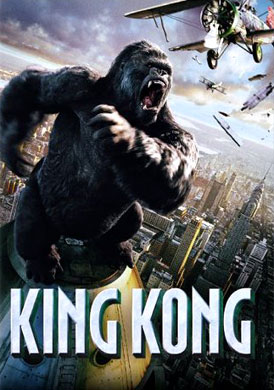
Monster Movie of the Week: King Kong (2005)


KING KONG (2005)
Director: Peter Jackson
Genre: Adventure/Tearjerker

THE MOVIE:


King Kong has been around the block a few times. He starred in the classic 1933 movie and its sequel, a couple of Japanese movies (including one in which he fought Godzilla and in another he fights Mechanikong) and a 1976 remake and its sequel. And let’s not forget all of the giant ape copycat movies that Kong inspired. One could have been forgiven for thinking that the 2005 remake was less than necessary (especially after the disappointing Godzilla remake in 1998).However, when you have a filmmaker like Peter Jackson-who was at the height of his creative powers having just finished the Lord of the Rings Trilogy-it changes the equation a bit.


The most important factor was that Peter Jackson absolutely loves and respects the original 1933 movie. One has to only see the extras on the DVD of the original King Kong in which Jackson painstakingly recreates the lost Spider Pit sequence using only 30’s era technology. You can clearly see that this is the lucky guy who loves what he is doing.Again, I have to go back to Emerlich and Devlin’s Godzilla remake. Here were two guys who were given a brand and were told they could do what they wanted with it. They had no particular love or interest in the original series and decided to do a remake that had almost nothing to do with the original Godzilla movies. In contrast, Jackson took the original movie, knew there were things he could do to better realize it, and made a movie that might have been very similar to what the original filmmakers would have done if they had the 2005 technology at their disposal.We all know the story of Kong. We all know how it ends. But what really works in this version is the relationship between Anne Darrow (Naomi Watts) and Kong (mo-cap by Andy Sirkis, who did similar duty on Gollum in the Lord of the Rings movies.) Really, the whole movie hinges on this relationship. In past versions of the story there is an element that is, shall we say…creepy…about this pairing. I think the previous versions of Kong have been informed by an idea that he represents a sort of primitive Third-World sexuality focused on this white blond woman, whereas, Peter Jackson’s Kong behaves more like a real gorilla. He is presented as being isolated on Skull Island and is the last of his kind in a hostile environment. Anne is equally isolated and afraid to reach out to anyone. The fact that these two are able to form such an important connection is very beautiful and touching and gives the movie its center, and makes this version of King Kong the great unconventional love story it was always meant to be. Respect for Watts and Sirkis for being able to bring this relationship to the forefront despite several layers of technology. Peter Jackson once again shows that he can make a big budget special effects movie that focuses on character, relationships and emotion.

THE MONSTER/EFFECTS:

The greatest special effects application is the use of motion capture which allows Kong to be inhabited by actor Andy Sirkis resulting in an actual performance and not just an animation. This is part of the reason that the film is so successful and heartbreaking because you really feel invested in Kong as a character and not a guy in a monkey suit, a stop motion puppet, or a giant animatronic head.


There are a lot of special effects in this movie, from the obvious creature effects to the more subtle effects used to create or enhance environments. There’s nothing necessarily groundbreaking but all the effects are well executed.

MONSTERS FEATURED:

Skull Island is crawling with monsters. There are dozens of dinosaurs, from T-Rex and Raptor analogues to larger sauropods. There are bugs galore, including giant man-eating wetas. There are some creatures that defy description such as one that I can only call the “Foreskin monster.”

Much like James Cameron's Avatar four years later, King Kong attempts to create an ecosystem (although an impossible one; Skull Island would have to be huge to support all of those dinosaurs). There is even a great companion book to the movie, The World of Kong: A Natural History of Skull Island, which is book of concept art for the movie disguised as a guide book to the flora and fauna of the island. The main idea behind Jackson's concept for Skull Island is that it is a place where prehistoric animals never went extinct and continued to evolve for the last 65 million years, so they are not exactly as we know them from the fossil record (hence the V-Rex being slightly different from its extinct ancestors).

MOST MEMORABLE SEQUENCE:

V-Rex Fight. Kong fights three V-Rexes, on a cliff, suspended on vines and on the ground, mostly while holding on to Anne. And the absolutely heartbreaking end of the movie.

DVD AVAILABILITY:

There have been several releases on DVD. The Extended Edition restores about 22 minutes of footage, including the river raft sequence that features an giant fish that resembles Giger’s Alien more than a little bit. Although, the movie does take its time getting going so the extra 22 minutes might be a dealbreaker for some people. There are plenty of other documentaries and extras.

Most, if not all, of these features are available on the Bluray version of the movie, which features both the theatrical and extended cuts. Like many Blurays, the featurettes and other supplemental materials are only available as branching features while watching the movie. What the hell is up with that anyway?

SEQUELS:

None planned or needed.

SEE ALSO:

King Kong* (1933), King Kong (1976)

TRAILER:


*The 2005 Collector’s Edition of the 1933 movie features extensive interviews with Peter Jackson in which he talks about his love for the movie. It also features a very interesting documentary in which Jackson’s 2005 Kong crew attempts to recreate the infamous and lost “Spider Pit” sequence using technology available in the 30’s. The documentary takes you through the whole process and you get to see the final recreation of that scene.