Tuesday, August 16, 2011

Monster Movie of the Week: District 9 (2009)


DISTRICT 9
Directed by Neill Blomkamp
Genre: Science fiction/Body Horror/Action

THE MOVIE

A sleeper hit back in 2009, District 9 stands out as one of the best science fiction films of the naughts, with great special effects and performances as well as thought provoking themes that, like many of the greatest sci-fi films, feature a veiled social commentary. This movie was so well-received that it was even nominated for a Best Picture Academy Award, which is a rare feat for a genre movie like this.

District 9
was produced by filmmaker Peter Jackson and helmed by first-time director Neill Blomkamp. The two had originally teamed up to make a movie adaptation of the popular video game Halo but after that project fell through, the commenced work on a project that Blomkamp had been thinking about for a while, a story set in an alien refugee camp in South Africa, which would be an expansion of his 2005 short film, Alive in Joburg.


District 9
quickly establishes a faux-documentary style (which it abandons when convenient) and introduces its protagonist, the feckless bureaucrat Wikus van de Merwe, who comes across as an Afrikaner version of Michael Scott from The Office. The movie uses "archival footage" to show the aftermath of the arrival of a massive alien ship over Johannesburg and how humanity had cut its way into the vessel to find a population of starving insect-like beings, who were eventually relocated to District 9, which has become a squalid shanty town by the beginning of the movie.


Wikus is tasked by the giant multinational company that operates District 9 to obtain signatures so that there can be some semblance of legality when the aliens are forcibly relocated to District 10, a new, more prison-like settlement. The aliens, who are referred to as Prawns by the humans, are largely considered of sub-human intelligence (it is speculated by the humans that they were the ship's workers and subservient to another group of aliens, unseen in the movie) and are mostly uneducated and easily manipulated (they have a strange obsession with catfood). However, the movie soon introduces us to the alien known as Christopher Johnson and his young son. Christopher, unlike most of the other aliens, can read and reason and has been toiling away on a secret project involving a mysterious cylinder filled with an unknown substance.

When Wikus comes across this cylinder while doing his rounds, it sprays him in the face and initiates a transformation that recalls that of Jeff Goldblum in The Fly. Wikus' hand suddenly begins to change into something resembling one of the prawns and he soon finds himself on the run from the government and his former corporate employers. He turns to the only place where he can hide: District 9.

Arriving at the shack of Christopher Johnson, Wikus learns that the cylinder is the missing component of the long lost command capsule that will allow Johnson to return to the alien ship and escape from the Earth with his son. He also promises that, once on the ship, he will be able to treat Wikus and reverse his transformation.

Needless to say, things don't go as planned. District 9 really kicks up the action in its last act, almost jarringly so for those who had been previously invested in the movie's heavy themes and interesting characters. The ending is fairly open-ended, and there's plenty of room for a sequel or two. District 9 is a great movie, although there are some story things that don't make a whole lot of sense, like who being sprayed in the face with fuel would change one into a totally different species or the mysterious disappearance of the beings that were actually running the ship, conveniently leaving behind these "primitive" creatures or how the alien ship is not crawling with human technicians when Johnson arrives on it.

The movie takes what could have been a very heavy handed analogy-the Prawns as proxies for black South Africans during apartheid-and deftly creates a story that stands on its own but feels very rooted in our world. Like the fantastic Alfonso Cuaron movie, Children of Men or Duncan Jones' amazing Moon, District 9, takes the world that we live in, adds a sci-fi premise and extrapolates a believable future from it. Corporate exploitation, poverty, tribalism, these things are all fodder for District 9 and, even without the inconsistent documentary style, make it feel like something that could actually happen.

THE MONSTERS/EFFECTS

Where the movie really shines is the realization of the prawns both in design and characterization. Despite the fact that he is a revolting bug moo-cap creature, I actually found myself deeply invested in Christopher and by the end of the movie I was very concerned about his fate. His relationship with his small son is quite touching and provides a nice emotional hook allowing the audience to empathize for the rather alien-looking prawns.


Designwise, the prawns are pretty good creatures and mostly avoid the "Cloverfield trap" of creature design, which is to make monsters into incomprehensible wasp-waisted hodgepodges of different scary animals. The prawns are a pretty coherent design and not overly complicated, so that you can take a quick look at them and understand how they work. They are bipedal insectoids, seemingly with a chitinous exoskeleton, and generally of human height or taller.

They possess a pair of large antennae on their heads which are covered in movable plate-like scales, which allow them a good amount of recognizable facial expression. Unlike most arthropods, they posses lensed eyes with a distinct pupil, a design decision that makes them easier to relate to than, say, more bug-like compound eyes. Instead of jaws or mandibles, they have a set of short tentacle-like organs that presumably hang in front of their mouths. The prawns do not speak English in the movie but in their own alien language of clicking sounds. Their dialogue is subtitled for the audience and understood by the human characters who are trained to interact with them.

MOST MEMORABLE SEQUENCE

During the movie's climax, there is a harrowing sequence in which Christopher Johnson has to race to the crashed command capsule where his son is waiting for him. By this point, I was so invested in this relationship that I was practically cheering for him to get to his son in one piece. And I really hate bugs.

HOME VIDEO AVAILABILITY

District 9 is widely available on DVD and Bluray. The Bluray transfer is really nice and brings out a ton of detail, really showing this movie off in its squalid glory. The movie has also been available on-and-off for Netflix streaming.

SEE ALSO

Rise of the Planet of the Apes (2011) is another tale of man's relationship to a mistreated, non-human "other" which also features amazing mo-cap/CGI characters that are far more compelling than the humans in the movie.

THE TRAILER


Patrick Garone
Follow Me On Twitter
Author of City of the Gods: The Return of Quetzalcoatl

Friday, August 5, 2011

Monster Movie of the Week: Cowabunga Edition! Teenage Mutant Ninja Turtles (1990)

TEENAGE MUTANT NINJA TURTLES (1990)

Directed by: Steve Barron

Genre: Superhero/Martial Arts

THE MOVIE

Having been a kid in the 1980’s as part of the Star Wars/GI Joe/Tranformers/He-Man generation, I narrowly missed the Teenage Mutant Ninja Turtle craze which began with a series of edgy and satirical comic books and carried over into a cheesy cartoon show, toy line, and video game series, all of which exploded in the late 1980's. The movie came at the height of the Turtles phenomenon and was a big hit and, for a time, the highest grossing independent film. It can also be argued that it helped to repopularize the martial arts movie as a genre (as did Mortal Kombat five years later) because in 1990 it would have been unthinkable to have a foreign language martial arts movie showing in wide release and now it’s not uncommon.


The movie takes a tone that is more in line with the comic book than the cartoons and is actually fairly violent for a PG movie. It has a very gritty early 1990's feel, and many scenes take place on dark and wet New York streets full of crime and delinquents. Also typical for the time are the many sinister Japanese accented-characters ("We've been rooking for you, Mss. O'Neir.") as the early 1990's was the heyday of Japan-ophobia in American popular culture.


It is the origin story of the Turtles, four mutant turtle brothers who have been trained as crime fighting ninjas by their mutant rat master, Splinter. The Turtles are caught up in a crime wave brought about by an organization called the Foot Clan, headed by a man named Shredder. Also mixed up in the story is a reporter named April O’Neil and a sports equipment-wielding vigilante called Casey Jones, played by the great character actor Elias Koteas.


THE MONSTERS/EFFECTS


Creature-wise the movie features the four Turtles and Splinter, all created by Jim Henson Studios and are nicely done with very expressive animatronic faces. When you think about it, the amount of martial arts is very impressive considering the bulky costumes. Unfortunately, the Turtles are only really distinguished by the color of their ninja masks and their weapons. With the exception of the bad-ass Raphael and possibly Michelangelo (who speaks in a grating "Valley Dude" style that has not aged well) they are not very well distinguished from one another as characters either via performance or design. The Splinter puppet, however, is quite nicely designed and looks as life like as an aged anthropomorphic rat can.


SEQUELS


There were two direct sequels to the live action movie (of descending quality) and the recent TMNT which is a CGI film in the same continuity as the live action films.


MOST MEMORABLE SEQUENCE


The Casey Jones/Raphael fight. Although, the sequence of the pre-mutant Splinter practicing martial arts in his cage is memorable for being totally ridiculous.


HOME VIDEO AVAILABILITY


Widely available in a no frills DVD release. Also as part of a Bluray set with its sequels, although missing the extra features one would expect.


TRAILER


TRIVIA

Actor Sam Rockwell appears in an early role as one of the teenagers working in the Foot Headquarters.

Friday, July 29, 2011

Monster Movie of the Week: Escape from the Planet of the Apes (1971)

Escape from the Planet of the Apes
Directed by Don Taylor
Genre: Sci-Fi

The third film in the Planet of the Apes series, Escape from the Planet of the Apes, is widely considered one of the best of the franchise. It deftly manages to mix science fiction with gentle comedy and social commentary and gets the most out of the sheer likability of its two stars, Roddy McDowell and Kim Hunter. Both actors reprise their supporting roles from the classic 1968 movie but are here allowed to carry the entire film without Charlton Heston chewing the scenery.

Escape is actually the movie that is closest in tone to the original Pierre Boule novel on which the first movie was loosely based. The Boule story featured a Twentieth century astronaut who encounters an advanced ape civilization on a distant planet. Its emphasis was less on science fiction and action and more on satire and social commentary. The same is also true of Escape which features the chimps Zira and Cornelius as outsiders stranded in 1970's America who give the audience a satirical point-of-view on contemporary life. Escape takes some of the situations from the original movie and inverts them in a fun and interesting way and serves as a thematic book-end to the original movie.


The movie is a fairly light-hearted romp with dark undertones which come to dominate the last third of the film and lead to one of those violent and shocking endings for which the series is infamous. The ending is rather jarring considering the comedic tone of most of the movie, but it wouldn't be an Apes movie without something big going down at the end. Still, it's not easy watching a pair of characters in which you have become invested get mercilessly gunned down.


Escape from the Planet of the Apes actually begins with a rather neat twist. The opening sequence involves the recovery of a space capsule, much like the one used by Heston's character in the original movie. When the astronauts remove their helmets they are revealed to be the chimps Zira, Cornelius and their companion, Dr. Milo. Although, the premise of these apes fixing and piloting one of the two damaged ships is far-fetched even for a Planet of the Apes movie, it does make for a terrific cold-open and is a pleasant reminder that this is going to be a different Apes movie than the original or its carbon-copy sequel.


After Dr. Milo succumbs to a tragic accident, we follow Zira and Cornelius as they explore Twentieth century Earth and become celebrities. We even learn that Zira is pregnant. However this is a shadow hanging over the good times, as forces in the American government are very curious about the future planet of the apes and they want to know all they can to prevent it from happening. They soon begin to see the two chimpanzees and their offspring as a threat to humanity's future, which leads to a tragic sequence of events during which the two chimps are gunned down but not before hiding their super-smart chimp baby...

THE CREATURES/EFFECTS

Although the rule with the Apes movies was that less and less money was spent on each installment, it actually serves this movie really well as there are only three ape characters which require make up, and they are all sporting the Oscar-winning John Chambers make-up, much as they did in the first movie. You won't find any of the awful crowd scenes from the prior and subsequent movies where extras are forced to don awful rubber ape masks. This movie is all about Zira, Cornelius and (briefly) Milo. Baby Caesar is portrayed by an actual baby chimp.

MOST MEMORABLE SEQUENCE

I'm a big fan of the great cold open and the title sequence which features another great score by Jerry Goldsmith, although this time with a bit of '70's funk thrown in.


HOME VIDEO AVAILABILITY

Like the rest of the series, Escape has been widely available on its own and in a variety of great collectors sets. Apes fans are in luck that this a 20th Century Fox production, as they have a well-deserved reputation for putting out first-rate Bluray sets and the Blurays even blow the amazing DVD set out of the water with its wealth of special features intuitive navigation system.

SEQUELS

Directly followed by the really interesting Conquest of the Planet of the Apes, which was released the following year and told the story of baby Milo's (now Ceasar) ape revolution.

TRAILER


Patrick Garone
Follow Me On Twitter
Author of City of the Gods: The Return of Quetzalcoatl

Tuesday, June 21, 2011

Monster Movie of the Week: Godzilla VS Destoroyah (1996)


GODZILLA VS DESTOROYAH (1996)
Director: Takao Okawara
Genre: Kaiju eiga


THE MOVIE


Ah, the best laid plans of mice and monsters...While Toho was hard at work on their beloved Heisei series of Godzilla movies, they were working behind the scenes to make an American Godzilla movie. In the mid '90's, it became clear that this was finally going to happen and Toho began toying around with plans to kill their Godzilla to make way for a series of movies produced in the US. While they had considered killing Goji off at the claws of his powerful opponents Mecha Godzilla and Spacegodzilla, they ultimately decided to have the big guy finally meet his match in the form a new monster, Destoroyah who was born of the very weapon which killed the original Godzilla in his 1954 movie. Since the filmmakers were treating this as the "final" Godzilla movie there are lots of cool connections and homages to the original film.

The story begins with a catastrophic event on Birth Island, the remote location where Godzilla and Junior make their home in the Heisei movies. Junior is presumed dead and the eruption triggers some sort of nuclear meltdown in Godzilla, with large patches of his body literally red hot. The Japanese defense force predicts that the monster will die in an explosion which will destroy life on Earth. They begin experimenting with various ways of bringing Godzilla's temperature down, including freezing rays.

Meanwhile, another scientist begins working on a similar technology to the Oxygen Destroyer developed by Dr. Serizawa (the scientist who gave his life to stop the monster at the end of Gojira.) He soon discovers that a strange life form has developed at the exact spot where the weapon had been used in 1954 and these small creatures escape the lab and begin to grow and change in the outside world.

They grow into larger car-sized monsters and are dubbed "Destoroyah." The creatures multiply in an industrial location and soldiers are sent in to kill them. While it is a nice change of pace to see creatures of this scale in a Godzilla movie, this sequence is shamelessly derivative of Aliens, complete with motion sensors and double-jawed creatures.

The Destoroyahs are able to combine into a larger aggregate form and begin wreaking havoc on Japan when Godzilla junior resurfaces and attempts to take on the larger monster only to be handily (and viciously) defeated by him. After being dropped from a great height and being bitten and exposed the very same substance that killed the original Goji, Junior is fatally wounded. Godzilla arrives and is really not happy about the scene he finds, plus he is having a crappy day in general, what with being about to explode.

After a great struggle and with assistance from the defense force, Godzilla defeats Destoroyah. In an attempt to contain his impending meltdown, the JDF shoots Godzilla with a freezing ray from their airship, which mitigates his explosion. Instead of destroying the planet, the meltdown only affects Tokyo. It also has the effect of reviving Godzilla junior, who, thanks to the energy absorbed from his adopted parent, is now a fully-grown Godzilla. The movie ends with credits over select clips from the original movie and the other Heisei movies accompanied by Akira Ifukube's Godzilla March, as a kind of eulogy for the character and the series.


MONSTERS/EFFECTS

While he largely features the same suit as in his previous movie, Godzilla vs Spacegodzilla, this version of Godzilla features his iconic "meltdown" look, with illuminated patches of red and orange all over his body. This is a very striking look for the character and one that has not been used in any other media (save for a similar non-character-specific power-up in the Nintendo Wii fighting game, Godzilla Unleashed). Godzilla's biology is not something that had been really explored in other movies, and I'm glad that his appearance in Godzilla vs Destoroyah highlights the fact that Godzilla is, in fact, a dangerously unstable creature. I always liked the idea that beyond the physical damage caused by Goji, there would be a lot of collateral damage caused by fall-out and radiation. Destoroyah takes this idea and runs with it, playing with the idea that Godzilla simply has too much power to be contained in his body


The star creature has the Engrish-sounding (but copyrightable) name of Destoroyah. The idea of Destoroyah is pretty cool and the fact that he is born of the device used to kill the original Godzilla is nicely ironic as he was to serve as the big guy's final opponent. Also cool is his Hedorah-like ability to take on different forms. Sadly, the effects are not up to par when it comes to bringing these forms to life.

His immature, crab-like form is heavily featured in the movie and represents a scale we don't often see in Toho's kaiju movies but the puppets and animatronics are not entirely convincing. They are shot from tricky angles meant to hide their mechanisms and they also don't move in a convincing way. This is particularly true when they attempt to swarm Godzilla later in the movie which compares unfavorably to a scene in Gamera 2: The Attack of Legion released the same year which features a similar but much better-executed effect.

The adult monster Destoroyah comes off a little better but there is something almost Power Ranger-y about his design. He almost has too many cliched monster parts: giant bat wings, a horn, a long tail with a pincer on the end, a dino-like crest. And why does he have feet on his knees? He also does not really look like a creature that is composed of other, smaller creatures, which he supposedly is. He does, however, have tons of malice and even gives Spacegodzilla and Ghidorah a run for their money as some of the most evil kaiju in Toho's stable. His most despicable moment comes late in the film when he actually succeeds in killing Godzilla Junior in a very graphic way.

Speaking of Junior, he has undergone quite a growth spurt and now actually looks like something that is related to Godzilla for once. In fact, he looks much like the adult Godzillasaurus from Godzilla vs. King Ghidorah. It's nice that he has finally come into his own and that he has an actual character arc of his own. With his resurrection at the end of the movie, he effectively becomes the new Godzilla.


HOME VIDEO AVAILABILITY

Available on double sided DVD with Godzilla vs Spacegodzilla. Also streaming for free on Crackle.com.

MOST MEMORABLE MOMENT

As Godzilla begins to meld down his trademark spines begin to actually melt from his back. It's at that moment you are like, "Holy crap! This is really goin' down!" The sequence a little bit later on of Godzilla literally melting is actually very cool and it is one of the most unforgettable sequences in the whole series.

SEQUELS

Godzilla vs Destoroyah is the last of the Heisei series and a kind of valedictory round for the monster. While it was originally envisioned as the last of the Japanese movies for the forseeable future, the failure of the American movie and competition from the surprisingly good Gamera movies (which started in 1995) forced Toho to amend their plans and Godzilla was back in Japanese theaters three years later with Godzilla 2000.

While G2K was a new Godzilla movie, it was not necessarily a sequel to anything but the original Godzilla movie (although some people see it as featuring Godzilla Jr, though the events of the Heisei series are not referred to in any of the Millenium movies, which are almost all set in their own continuities).

Destoroyah is not featured in any other Godzilla movies, although he does appear in various video games such as the Atari fighters, Godzilla Save The Earth and Godzilla Unleashed.

TRAILER


Patrick Garone
Follow Me On Twitter
Author of City of the Gods: The Return of Quetzalcoatl

Monday, June 13, 2011

Monster Movie of the Week: Godzilla vs. Spacegodzilla (1994)


GODZILLA VS. SPACEGODZILLA
Director: Kensho Yamashita
Genre: Kaiju eiga

THE MOVIE

After a trio of 1990's movies that brought in some classic monsters like Ghidorah, Mothra, Mecha-Godzilla and Rodan, Toho decided to (sort of) create a brand new kaiju to face off against Goji in 1994's entry to the series. Godzilla vs. Spacegodzilla is the penultimate movie in the Heisei series and is widely considered to be a low-point due to it's derivative monster (another Godzilla clone), uninteresting human story (even for a Godzilla movie) and the presence of MOGUERA, a mecha who is only in the movie because of its weakness. But despite its flaws, Spacegodzilla offers some good action, and, Goji wannabe aside, Spacegodzilla is quite a fearsome opponent and one with a unique set of powers.

Godzilla taunts Spacegodzilla's lack of shoulder movement.


In Japan, competing Defense Force projects arise to deal with Godzilla. Psychic Miki Saegusa heads a plan to implant a device that will allow her to control Godzilla enough to steer him away from inhabited areas. Others have built a new robot from the remains of Mecha Godzilla, dubbed MOGUERA, with which they hope to destroy the mutant dinosaur once and for all. Meanwhile, Mothra is still in space but sends warning of a space monster that is heading for earth and which seeks to destroy Godzilla and conquer the planet.

The monster lands on Birth Island and attacks Baby Godzilla, encasing him in a crystal pit. When Godzilla arrives and attempts to rescue the the infant, the space monster dispatches him with ease. Scientists surmise that this creature evolved from Godzilla cells sent into space by Biollante and which evolved in a crystalline environment. They dub this new monster Spacegodzilla.

After a side plot about the Yakuza attempting to capture Miki, Spacegodzilla arrives in Fukuoka and starts turning it into his own Fortress of Solitude, creating giant crystal towers from which he conducts power into his massive shoulder crystals. It takes the combined might of Godzilla and MOGUERA (well, mostly Godzilla) to destroy the crystals and take down Spacegodzilla. In the end, Miki psychically pops off the control device and Godzilla and Baby Godzilla make their way back to Birth Island.

At robot parties, MOGUERA is taunted by Go-Bots.


THE MONSTERS/EFFECTS


The star villain is, of course, Spacegodzilla who is basically a larger Godzilla with many crystal embellishments to the design, most noticeably the large crystals on his shoulders, which give him a very unique appearance but also somewhat hinder the motion of his arms. It would have almost have been cool to have given Spacegodzilla smaller T-Rex arms, since that's about the range of motion anyway. His immobile shoulders give him a bit of an awkward appearance.

The basic design of Spacegodzilla is drawn from an old Super Nintendo game, Super Godzilla, which featured a "powered-up" version of the King of the Monsters with a similar v-shaped silhouette, but here crystals are incorporated into the design. Instead of the rows of dorsal spines, Spacegodzilla has a row of spiky crystals on his back and his tail ends in a glassy club. He is somewhat larger than Godzilla and he also seems a good deal fatter, with remarkably obese-looking legs.

Spacegodzilla features a toothy and very mean-looking head. There seems to be some Biollante inspiration in the form of the tusk-like teeth in the corners of his mouth. On the top of his forehead is a tiara-like gem giving him a regal appearance. Spacegodzilla also has the ability to wrap himself in a kind of diamond cocoon which he uses to travel through space and even on earth.

Spacegodzilla has a distinctive set of abilities that are pretty unique among Toho's kaiju. Many of his "cosmic" powers are based on telekinesis, such as his ability to levitate and grab and throw his enemies. He also uses his crystal towers offensively to shoot beams and fire projectiles. In addition he is able to shoot a "corona beam" from his mouth. He is really one of the more powerful kaiju that Godzilla has confronted.

On top of his many abilities, Spacegodzilla has the distinction of being one of the more evil monsters in the Godzilla series. This is particularly evident on his arrival on Birth Island when the confused Baby Godzilla attempts to greet him only to have Spacegodzilla viciously attack him. Spacegodzilla stands among King Ghidorah and Desotroyah as the most malevolent of Godzilla's opponents. It would have been interesting to have been able to get into his head a little more. He was said to have been attracted to earth to kill Godzilla but we never find out why.

Not even scaffolding and dramatic lighting can make MOGUERA look cool.


MOGUERA, on the other hand, is about as threatening as Johnny 5. Rumor has it that the part was originally written to feature Mecha-Godzilla again but that the filmmakers thought that it would be too uneven to have both Godzilla and Mecha-Godzilla teaming up against Spacegodzilla. And also too many Godzilla-derived creatures. So Toho resurrected their old robot Moguera who had been seen in The Mysterians and gave him a '90's makeover, but he still manages to be incredibly awkward, with his beaky face and huge child-bearing hips.

Spacegodzilla is also a trendsetter, it turns out.


MOST MEMORABLE SEQUENCE

Spacegodzilla's unprovoked attack on Baby Godzilla stands out as the ultimate dick move in any Godzilla movie.

SEQUELS


This movie is immediately followed by Godzilla vs. Desotroyah, which closed out the Heisei series and "killed" Godzilla to make way for the American version of the character.

This is the only movie to-date to feature Spacegodzilla, although he appeared in the video games Godzilla Save The Earth and Godzilla Unleashed as a playable character. His crystal and psychic attacks make him one of the more fun and unique characters in both games. He is also set to appear in the new Godzilla: Kingdom of Monsters comic series.

MOGUERA also appears in both of the above games as a playable character. Instead of having a signature roar, MOGUERA has the ability to say his own name. Yeah...

HOME VIDEO AVAILABILITY

Available on a double feature DVD with Godzilla vs. Desotroyah and also viewable for free on Crackle.com.

TRAILER


Patrick Garone

Author of City of the Gods: The Return of Quetzalcoatl

Tuesday, June 7, 2011

Monster Movie of the Week: Godzilla Vs Mechagodzilla II (1993)


GODZILLA VS MECHAGODZILLA II
Director: Tokao Okawara
Genre: Kaiju eiga


The Heisei series marches on with Godzilla Vs. Mechagodzilla II, which is in no way a sequel to Godzilla Vs. Mechagodzilla. As part of their then-plan to reinvent their classic kaiju, Toho brings back the popular Mechagodzilla, who was introduced at the end of the Showa movies. Also returning is Rodan, a popular monster both from his own movie and numerous appearances in Godzilla's 1960's movies. Toho even sort of brings back Minya in the form of Baby Godzilla.

One of the cool things about the Heisei series is that it features a rather tight continuity and events from previous movies have an impact on later films. In GVMII, scientists salvage the remains of Mecha King Ghidorah (who was created by the Futurians as a Godzilla deterrent but defeated at the end of Godzilla Vs. King Ghidorah) and use his remains to construct a new mechanical Godzilla-like mecha as the ultimate weapon to defeat the King of the Monsters.

Meanwhile, explorers on a remote island discover what appears to be a giant dinosaur egg. They attempt to remove the egg but are attacked by Rodan and then Godzilla. Both monsters battle until Rodan is defeated. During the fight, the egg is removed and taken to Tokyo for study. The egg hatches revealing an infant Godzillasaurus (the remnant dinosaur species that became Godzilla when exposed to nuclear testing in the 1940's).

Mechagodzilla then engages Godzilla for the first time and is able to give Godzilla a run for his money for a while, but Goji ultimately prevails against his metal doppleganger. In preparing for their next attack on Godzilla, scientist discover that Baby Godzilla has a second brain near his tail that handles lower body functions. The scientists plan to use this weakness to disable Godzilla so that their new mecha can finish him off once and for all.


The Defense Force decides to use Baby Godzilla as bait to lure the adult, but instead they attract Rodan, who had developed a protective bond with the egg. Rodan engages the giant robot but is defeated. Godzilla finally arrives and the plan works when Mechagodzilla manages to injure Goji''s second brain, paralyzing him. Rodan comes to Godzilla's rescue and with his last strength manages to transfer his energy to Godzilla, repairing his damage and allowing him to defeat Mechagodzilla, rescue BabyGodzilla and swim off to safety.

Godzilla Vs. Mechagodzilla II is a decent entry to the series but actually poses more questions than it answers. What's up with there being a second Godzillasaurus? If Godzilla has a such an accessible weak spot why is it never mentioned again? The presence of Rodan is never really explained, he's just sort of found hanging around the Godzillasaurus egg. While it's great to see him, the movie could have done a better job introducing him and offering some sort of explanation for his presence.


THE MONSTERS/EFFECTS

While Godzilla is little changed from he previous 1990's outings, the film does offer three re-invented kaiju to marvel at. The best of the three is the redesigned Mechagodzilla, who trades his primitive bolts-and-plates look for a sleek and curvy redesign. This Mechagodzilla looks like more of a sports car than a tank. But don't let his make-over deceive you, like his predecessor, Mechagodzilla is one of the most powerful kaiju of his time, with some very impressive weaponry, including a pair of shock cables, numerous missiles and laser cannons, a shock beam in his mouth, and a chest-mounted plasma grenade launcher. On top of all that, he is able to combine with the battle ship Garuda, which connects to his back and gives him additional firepower and booster rockets.


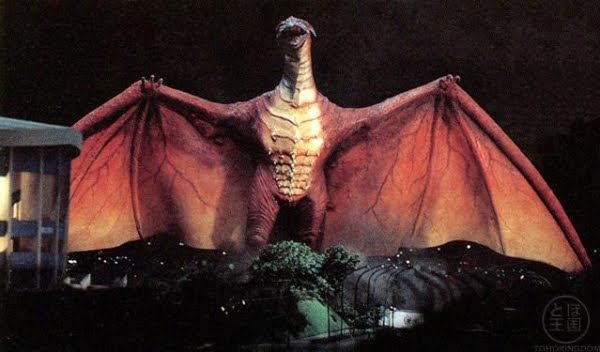
Rodan also gets a bit of a makeover in GVMII, for the first time being portrayed wholly by a puppet as opposed to a suitmation actor. Without the actor inside, Rodan is able to be portrayed a little more pterodactyl-like than previous version. Also, his head has been redesigned to accommodate a longer beak and he is given a third horn. Overall, the puppet has been given a more realistic color scheme and detailing, such as the appearance of veins in Rodan's wings.

This version has been dubbed Fire Rodan because of his uranium beam, and he is one of the more powerful versions of the character. Sadly, Fire Rodan still suffers from the limits of the technology used at the time and the flying sequences are less than convincing. Kaiju moves wouldn't get the flying effect right for another six years in Gamera III. Rodan's presence in the movie seems like a bit of an after thought and I have a feeling that his role might have been written for Mothra.

The other creature is Baby Godzilla who manages to be slightly more appealing than his hated Showa predecessor. It's actually kind of interesting that this movie was released the same year as Jurassic Park, in which the way dinosaurs were portrayed on screen would be forever changed. Baby Godzilla is realized with a man in a pretty awful dinosaur suit. Designwise, Baby G is meant to look "cute" and, like Minya, he is barely recognizable as being from the same species as Godzilla. Luckily, by the time we get to the end of the Heisei movies, he starts to look more like his adopted father. It may be heresy to say, but the American Godzilla did actually surpass the Japanese movies in the way it handled the baby Godzillas. They were mean little bastards as soon as they came out of those eggs.

MOST MEMORABLE SEQUENCE

Both battles with Mechagodzilla are quite good. This version of the character really gives Godzilla a good fight.


HOME VIDEO AVAILABILITY

Available in a bare-bones DVD.

TRAILER


Patrick Garone

Author of City of the Gods: The Return of Quetzalcoatl

Thursday, June 2, 2011

Monster Movie of the Week: Godzilla and Mothra: The Battle for Earth

GODZILLA AND MOTHRA: THE BATTLE FOR EARTH
Director: Tokao Okawara
Genre: Kaiju eiga

THE MOVIE

After the ho-hum reception to Godzilla Vs. Biollante Toho decided that they were going to bring back some of the popular monsters from their vast pool of characters. After Godzilla Vs. King Ghidorah, Toho decided to bring back the very popular Mothra for the third Heisei Godzilla movie and the result is Godzilla and Mothra: The Battle For Earth. While not a total remake of Godzilla Vs. Mothra, G&M revisits a lot of elements of the earlier Toho classic, which is widely considered one of the better movies in the series. Like the previous movie, there is a remote island, a mysterious egg, a pair of fairy-like twins, an environmental theme, and an evil corporation out to exploit Mothra. The 1992 movie does add a new character in the form of Battra, Mothra's dark doppleganger and ancient opponent.

Godzilla shows off the prize he won from cashing in his tickets at Dave & Busters.


A meteorite crashes into the Pacific and awakens Godzilla and also begins causing climatic disruptions. The meteorite also awakens a giant horned worm, which had apparently be slumbering beneath the sea as well. This new monster is aggressive and begins wreaking havoc.

Meanwhile, the storms reveal a giant egg on a remote island in the Pacific. A Japanese corporation sends in a crew to investigate, including a very Indiana Jones-like treasure hunter and his estranged wife. After discovering ancient cave paintings of battling insect monsters, they are contacted by the Cosmos, the miniature twins who speak for Mothra, an ancient Earth Guardian and that in the distant past she battled and defeated Battra, another guardian who had gone rogue. Battra-or at least another Battra-was sealed away beneath the sea until 1999 when he would rise again to intercept an asteroid headed for Earth.

When the company attempts the take the egg back to Japan, their ship is attacked by Godzilla, who is then attacked himself by the worm creature, now revealed to be Battra's larva. The egg then hatches revealing the Mothra larva. Battra battles Godzilla on the sea floor until both are trapped in a volcanic trench, leaving Mothra to swim away.

Later, Mothra spins her cocoon and hatches as the adult butterfly form of Mothra. Godzilla soon reappears as does the now adult Battra. The three battle until the two guardians join forces (after they apparently talk out their differences) to overcome Godzilla. The giant is defeated but Battra is killed, leaving Mothra to fulfill his task of intercepting the giant asteroid on a collision for Earth.


Can you blame him for being cranky?


All-in-all, Godzilla and Mothra is a decent entry to the Heisei series of Godzilla movies and a fun update of Godzilla Vs. Mothra. Battra is a pretty cool addition to the Toho pantheon. It's interesting to have a darker spin on the Mothra design, however his actions toward the end of the movie aren't adequately explained. Also unexplained is why the ancients would use him to thwart the asteroid if he was so dangerously unstable in the first place.

This movie adds the "Earth Protector" mythos to the Mothra story and gives her a role in ancient human history. This plot point is utilized even in the later Millennium movies and is pretty much the standard back story at this point as opposed to the primitive "island goddess" backstory that she used to have.


How'd you like to find that crawling around in your backyard?


THE MONSTERS/EFFECTS

Between Godzilla and the various Mothra and Battra forms, G&M has quite a bit of monster variety going on. Goji himself is largely unchanged from his look in Ghidorah. He retains the characteristic mammalian Heisei head and muscular upper body. One thing that has always struck me as weird about this version of Godzilla is that the upper half of his body is buff, yet he has enormous thunder thighs and cankles. He really needs to spread that work out around.

This version of Mothra was her first real appearance since 1968 and her re-introduction was only moderately successful. While the familiar larva design is actually pretty well done in G&M, the actual adult imago form leaves a lot to be desired. Often Mothra has suffered in Toho's movies from looking a bit like a plush toy and that is certainly the case here, where she looks like something you would pull out of a claw game. She's a bit too cuddly looking and it appears the puppet is totally flocked, even the wings. Needless to say, the flying is less than convincing, which is a problem that was not really solved until Godzilla Mothra King Ghidorah in 2001.

Perhaps a giant can of Raid would be useful?


Battra, however, is quite a cool design in both the larva and flying form. The designers took the basic Mothra larva form and made it a lot meaner and more aggressive-looking, with some bold colors, sharp scales and a giant horn, from which it shoots energy beams. The adult form is pretty cool as well and a lot less butterfly-like than Mothra. Battra has a kind of crown of horns and a more powerful-looking body with more robust legs than his counterpart. Interestingly, Battra does not need to spin a cocoon and simply transforms into his adult body. Also, Battra is able to fire lightning out of every orifice.

This is Battra's sole movie appearance but he does make an appearance in the Xbox game Godzilla Save The Earth as a summonable character. In the Playstation 2 version of Godzilla Unleashed he is a playable character, although he is just a clone of Mothra. He does make an appearance in the recent IDW comic series Godzilla: Kingdom of Monsters.

MOST MEMORABLE SEQUENCE

The end battle sequence is pretty cool and takes place at an amusement park. Battra sustains some pretty nasty injuries from Godzilla as the two Earth Guardians fly him out to sea.


SEQUELS

Followed by Godzilla Vs. Mechagodzilla II.

HOME VIDEO AVAILABILITY

On a double sided DVD with Godzilla Vs. King Ghidorah.

TRAILER


Patrick Garone
www.patrickgarone.com
facebook.com/cityofthegodsnovel

Sunday, May 29, 2011

Monster Movie of the Week: Alien VS Predator (2004)


ALIEN VS PREDATOR (2004)
Director: Paul Anderson
Genre: Sci-Fi/Survival Horror

THE MOVIE

The AVP concept goes back to the 1980’s when Dark Horse comics created a series of cross-overs using both the Alien and Predator licenses (of which they had been running successful comics series). The original story was set around the time of the Alien movies on a distant colony planet. It established that the Predator race kept the Aliens in captivity to be unleashed on distant planets to be hunted as part of their coming of age rituals. In the original comic, a group of human colonists are caught in the middle of the struggle and a lone female colonist teams up with a surviving Predator to destroy the Alien menace.

This was a very cool and exciting combination in the late 1980’s and spawned a slew of similar concepts featuring unlikely comics cross-overs (such as Robocop Vs. Terminator, Batman Vs. Predator, Superman Vs. Aliens, etc) and fans wondered if we would ever see a movie of AVP. We got a tantalizing hint at the end of 1990’s Predator 2 which featured a nice easter egg in the form of a bleached Alien skull among the trophies on the Predator ship at the end of the movie. In the early 2000’s, with the Predator series dormant after its only sequel and the Alien series having fizzled out with two financially unsuccessful movies, 20th Century Fox began to seriously consider doing a movie version of AVP.


They turned to Director Paul W.S. Anderson who had directed a number of hyperactive video game adaptations (Resident Evil, Mortal Kombat) that were popular with the Playstation crowd. This choice irritated a lot of people, particularly fans of the Alien movies who were used to a certain amount of respect for the material and quality directors. Also, irritating to fan boys was the continuity-bending fact that the film was to be set on Earth in the present (probably for budgetary reasons), and that the movie was being produced with a PG-13 rating in mind. Therefore, the movie was panned by hardcore sci-fi fans as well as critics who don’t like it when titles are not prescreened for them. Critics are also dismissive of anything with the word “versus” in the title, bringing to their minds Godzilla movies (to which I ask, what’s wrong with that?) As far as the tone of the movie, Anderson seems to be emulating Ridley Scott’s cool and austere British horror style more than James Cameron’s balls-on-the-wall American action movie style (like Scott, Anderson is a Brit). This might be another reason American fan boys don’t appreciate this much underrated monster flick.


So, what’s the deal with AVP? The movie has a lot going against it. The Earth setting is kinda dumb and negates the fact that the characters in the Alien movies were all working to keep the aliens from getting to earth. The characters are mostly dull. I hate the Jurassic Park-y exposition. The movie is frustratingly underlit and so frenetically edited that it is hard to see what is going on sometimes. What the hell are Predators doing in the Antarctic? And why do the Aliens mature so fast? What’s up with the ridiculously literal production design on the ice pyramid, with hilarious Alien and Predator hieroglyphics?


On the other hand, for all his reputation as a hack director, Anderson is clearly a big fan of the Alien and Predator movies and his film is filled with loving visual references to both the movies and the original AVP comics, which was pleasantly surprising. His knowledge of the Alien series and sci-fi in general goes deeper than expected and much of the inspiration for the pyramid comes from discarded early story ideas and concept art from Alien and much of the story itself seems to have been inspired by H. P. Lovecraft’s “At The Mountains of Madness.” There are even references to the fun but silly theories of ancient astronauts as proposed by Erich von Daniken.


The idea of a human female survivor who is “branded” into the Predator clan comes straight from the original AVP comic series from Dark Horse. And while the idea of Alexa suiting up with make-shift Alien weapons doesn’t work that well on film I have to respect that they put it in. It’s ironic that a movie that is such a labor of fan love is so reviled by fan boys.


THE MONSTERS/EFFECTS


One of the main reasons that I enjoy this movie so much is the fact that Giger’s Aliens have never looked better than they do in this movie. The Aliens go back to a classic design that resembles the creatures from the first and third movie with the domed head and they are brought to life with a combination of life-sized hydraulic puppet and CGI and as far as I know, there is no suit acting in this movie at all. This gives us Aliens that are more skeletal and less anthropomorphic than they have been before.


As I stated above, the Aliens in this movie seem to go from implant to chestburster to adult in a matter of hours (or perhaps even less) which is pretty fast compared to the previous movies. It seems to me in 1979’s Alien, the creature matures “overnight.” In Alien 3, the time period seems to be a day or two. These both seem too fast when you think about it but in AVP it is ludicrously fast. One gets the unpleasant feeling that the established continuity has been fudged to serve the plot needs of this movie. My own nerdy theory is that since these Aliens have been bred by the Predators to serve a particular purpose, they may have been altered to mature faster than normal. After all, it would suck to be a Predator and arrive at the temple only to be able to fight a bunch of chestbursters.


The Alien queen also makes a truly spectacular comeback in this movie after her rather lame appearance in Alien Resurrection. Her intro as she is frozen and chained in the bowels of the Antarctic temple is extremely cool and very inspired by the first AVP comic where she is similarly restrained aboard a Predator ship. She looks much like she did in Aliens only bigger, more skeletal and without the built in stiletto heels. Unless I am mistaken, she is completely CGI in this movie.


Unfortunately, the Predators in this movie don’t come out so well. Unlike the very tall and lean actor/dancer Kevin Peter Hall who played the Predator in the original two movies, the new Predators are very big and muscled and wear bulkier armor which gives them a weird linebacker-y appearance. Their arms also seem too short for their bodies. They also seem to have crazy extreme sports versions of their signature weapons. Their wrist gauntlets are now about four times longer than ever before and the very cool smart disc from P2 has been reimagined as a crazy giant throwing star. But, I guess if you are hunting aliens you need different equipment than if you are hunting humans.


MOST MEMORABLE SEQUENCE


The battle against the Queen at the end of the movie. Look at her go!


DVD AVAILABILITY


Widely available in a couple of different versions. There is an unrated version which is not that much different than the theatrical cut.

SEQUELS


Aliens Vs. Predator: Requiem, also enjoyable and a lot more graphic with a more American sensibility. If Anderson is trying to emulate Alien, then the directors of AVP:R are trying to emulate Aliens and Predator. You may enjoy one more than the other depending on your tastes.


TRIVIA


James Cameron has apparently seen this movie and enjoyed it.


TRAILER


Patrick Garone
twitter.com/patrickgarone
www.patrickgarone.com
facebook.com/cityofthegodsnovel